SUNDAY SCARIES: The Brands Worth Becoming
Last week's Scaries introduced species from the TNC Cultural Field Guide that quietly kill brave work. This week is the opposite — four species worth becoming. Not “aspirational brands.” Brands other brands should aspire to be.
1. The Calm Brand: Competes without urgency.
The Calm Brand doesn't confuse attention with love or presence with importance. It knows when to speak and, more importantly, when to step back. The relationship between the brand and its audience feels easy rather than engineered.
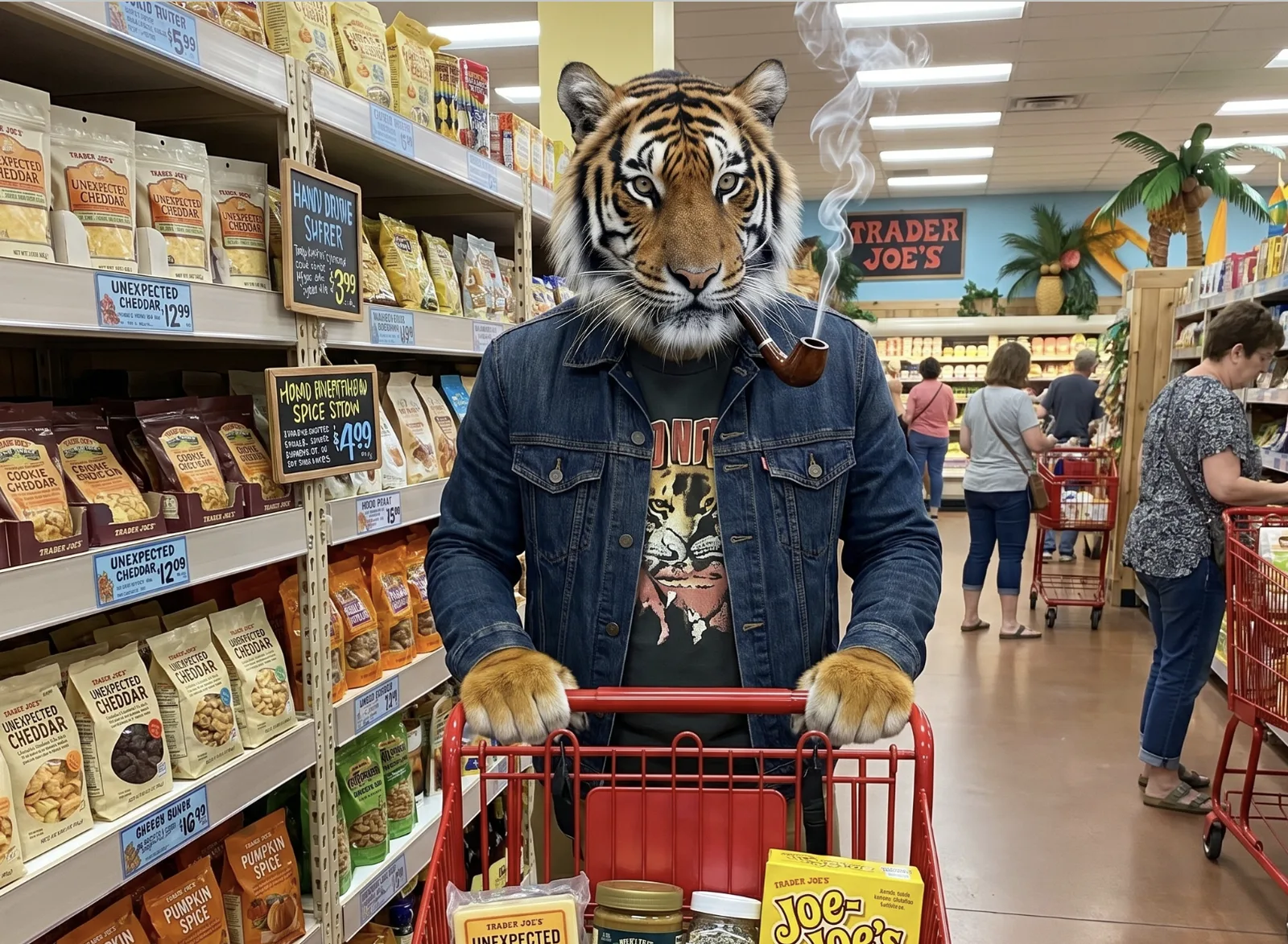
Acquired's deep study on Trader Joe's breaks down the math, and the numbers are impossible to ignore. The chain generates over $2,000 in sales per square foot — the highest of any grocer in the country, more than double Whole Foods. It has recorded higher absolute profits every single year since 1976 and has never posted a loss. Over 80% of what it sells is private label. And it does all of this with no advertising, no loyalty program, no coupons, no customer data collection, and no PA system in its stores. The company's philosophy boils down to one line from the piece: “Every 'no' is a 'yes' to independence.”
What makes Trader Joe's a Calm Brand isn't the restraint itself — plenty of brands are quiet because they can't afford to be loud. It's that their restraint is the strategy. They decided what they weren't going to do, and that decision freed them to be unmistakable at the things they kept. In a category full of brands screaming for attention through apps and rewards points and personalized discounts, Trader Joe's just put a cashier at the register who asks what you're making for dinner.
Takeaway: Calm isn't passive. It's what confidence looks like when it doesn't need validation. The species that survives saturation isn't the loudest one — it's the one people seek out when the noise becomes exhausting.
(Sources: Acquired Podcast, "Trader Joe's," October 2025)
2. The Human-Only Brand: Leans into authorship and imperfection.
The Human-Only Brand resists the urge to smooth everything out. It allows friction, texture, and personality to remain visible because those are the things that make it recognizable in a feed full of polished sameness. Judgment outweighs metrics.
Justin Bieber's opening-weekend Coachella set was one of the most talked-about performances of the festival, and he did it with a laptop and a collection of his old YouTube videos. No band. No choreography. No production design. He sat on stage, played clips of himself as a teenager, cracked jokes, and sang along to past versions of himself while the audience went crazy.
Dentsu's trends team wrote about it this week, trying to extract three brand lessons from the performance. The actual lesson may be simpler than any of that: in a festival built on spectacle, the thing people couldn't stop talking about was a guy being a person on a stage.
Bieber detractors thought it was lazy. Beliebers thought it was the most emotionally honest set in history. The truth is somewhere in the middle. (I'm personally not a fan). But the people who got it didn't need to be convinced, and the people who didn't weren't the audience. Bieber understood something that most brands still haven't figured out: when every other option is over-optimized and over-polished and over-engineered for maximum impact, imperfection becomes the most distinctive thing available.
Takeaway: As brands and platforms optimize everything, humanity becomes the biggest differentiator. The brands that lean into authorship are the ones people actually remember.
(Sources: Dentsu Creative US, "What's Trending," April 2026)
3. The Explainable Brand: Has a story that travels without the brand in the room.
The Explainable Brand is a 2026 version of the Albert Einstein adage, “if you can't explain it, you don't really understand it.” It is a brand that doesn't just have a story, it has a story that's easy to summarize, recommend, and repeat. When someone asks “what makes them different?” or “who are they for?” the answer comes out the same whether it's from a customer, an employee, or, most importantly, an LLM.
Think about The Ordinary: cult-like loved clinical skincare, transparent ingredients, honest prices. Ask a dermatologist, a Reddit thread, a beauty counter employee, or ChatGPT and you'll get the same sentence back every time. Or Costco: beloved bulk goods at wholesale prices, membership required. That's the whole pitch and it has been for decades. Both brands are so clear about what they are that other people — and now machines — can do the selling for them without supervision. That clarity isn't a byproduct of simplicity. It's the result of years of saying no to everything that would blur the description.
This matters more now than it did six months ago. Ad Age reported this week that OpenAI's ChatGPT ad program is scaling fast — over 600 advertisers in the first six weeks, a $100 million annualized run rate already, and a target of $2.5 billion in ad revenue this year on the way to a stated goal of $100 billion by 2030. Snooze.
But the most interesting data point isn't the revenue — it's the conversion math. Criteo found that users referred from ChatGPT convert at 1.5x the rate of other channels, even with click-through rates a fraction of Google's. Translation: fewer clicks, but the clicks come pre-qualified — the AI has already explained to the user why they'd want the product before they ever tap through. The recommendation IS the ad. And the brands the system can confidently describe are the ones it confidently recommends.
That's a fundamental shift.
On Google, you could buy your way to the top of a results page regardless of how clear your positioning was. In a conversational AI environment, the system has to explain why it's recommending you. If it can't summarize what you do and who you're for in a sentence that makes sense, you don't show up in the conversation at all. The Ordinary and Costco were already winning because humans could explain them to each other without a deck. Now the machines need to do it too, and the brands that gave them clear language are the ones getting recommended. The Explainable Brand was already a competitive advantage with humans. It's becoming a structural requirement with machines.
Takeaway: You're not being ranked anymore. You're being explained. And if a system can't confidently describe what you do and why it matters, you don't exist in that conversation — no matter how much you're spending to be there.
(Sources: Ad Age, "OpenAI ChatGPT Ad Program," April 2026; Jérôme Marin, "OpenAI's Ambitious Advertising Targets," April 2026)
4. The Paradox: Holds two contradictory truths at the same time and doesn't flinch.
The Paradox is maybe the rarest sighting in the field guide. This is a species that changes how the brand speaks without changing what it says. It updates the tone without rewriting the thesis. It reads culture carefully — not to chase it, but to find where the brand's permanent truth intersects with a temporary cultural shift. When it moves, the work feels both inevitable and surprising.
Brunello Cucinelli just posted Q1 2026 results: 14% revenue growth at constant exchange rates while the rest of the luxury sector is contracting. Business of Fashion called him “the tortoise to the luxury industry's hare”, which is probably the best one-sentence summary of the species. While competitors were chasing aggressive expansion, Cucinelli famously dismissed an investor who pushed for rapid growth, choosing instead to protect exclusivity. His response to them: “If you overdistribute your products, that's goodbye to exclusivity.” The brand targets 10% annual growth — not because it can't grow faster, but because growing faster would break the thing that makes it work.
What makes Cucinelli the Paradox and not just the Calm Brand is that the business is evolving constantly underneath the consistency. He just launched an AI-powered e-commerce platform. He doubled the artisanal factory in Solomeo — a town I would happily move to tomorrow.
From a design standpoint, he changes silhouettes and proportions every season, while the underlying thesis about craftsmanship, humanism, and restraint hasn't moved in decades. Consistency without evolution would make him a museum. Evolution without consistency would make him a rebrand every two years. He does both at the same time, and that's why the brand from 2016 and the brand from 2026 are clearly the same organism, even if you can't quite put your finger on what changed.
Takeaway: Sometimes you have to change to stay the same. The leaders who understand this don't resolve the tension. They tend to be the ones still growing when everyone around them is panicking.
(Sources: Brunello Cucinelli Q1 2026 Results, April 2026; Business of Fashion, "Does Brunello Cucinelli Have the Answers to Luxury's Problems?")
This Week's Red Thread: "The Ones Worth Becoming"
And then there's Allbirds…
A sustainable sneaker company once valued at $4 billion sold its brand name for $39 million to the company that owns Aerosoles, then announced it was pivoting to become an AI compute infrastructure company called “NewBird AI.” The stock jumped 600% on the announcement and gave back a third the next day.
Here's the part that's sort of sad: Allbirds was a genuinely great brand. The product was good, the positioning was clear, the story was real. People recommended it to each other unprompted — which is the highest compliment a brand can earn.
Then it went public. And the customers who loved the brand for its restraint became the shareholders who demanded it abandon restraint. More SKUs, more stores, more categories, more growth. The very thing that made Allbirds worth caring about was the first thing sacrificed to make the numbers work.
By February 2026, every U.S. full-price store was closed. By March, the brand was sold for less than the cost of a Super Bowl ad and in April, with a level of chutzpah from CEO Joe Vernachio that can't be overstated, the corporation renamed itself NewBird AI and the stock surged. From virtue-signaling shoe to stock pick to “something about GPUs” in under five years.
That's what happens when a brand stops being any of the species worth becoming. No calm. No authorship. No clarity. No paradox. Just a ticker symbol looking for its next costume.
The four species in this week's edition create coherence instead of optimizing for the sake of the system. They optimize for the brand's long term relationship with customers. None of them are doing anything revolutionary. They're doing something harder — staying coherent while everyone around them panics, pivots, or slaps “AI” on a press release and prays. The species worth becoming don't look exciting on a quarterly earnings call. They look inevitable on a ten-year timeline.
P.S. The full Cultural Field Guide — 9 genera, 30+ species — is free.
— NB