SUNDAY SCARIES: Where did this come from?
Yesterday, the sky over New Jersey rained actual soot from the Canadian wildfires, delivered by thunderstorm, leaving a film on the cars and flooding parts of NYC. Today it cleared just in time for the real visitors to attend the World Cup final a few miles south, off Exit 16W. And the FDA finally identified the source of America's loudest surprise guest, Explosive Diarrhea.
So we ask the question: WHERE DID THIS COME FROM?
1. The Homer Double Take
Christopher Nolan's The Odyssey opened Friday. A $250 million epic, shot on IMAX film, with demand strong enough to strain AMC's app and the biggest global launch of Nolan's career.
The same week, a “studio” called Fountain 0 unveiled Odysseus: The Fall. An epic 135-minute, fully AI-generated take on the same poem, created single-handedly by a guy named Ash Koosha, working part-time for three months, for what he calls “mid-five figures,” most of it cloud token credits. He cast his own face as Odysseus because he thought he fit the look of a Bronze Age Greek. It will be for rent from the Fountain 0 website for $9.99.
The timing was no coincidence. Fountain 0's chairman is Tom Rogers, the guy who co-founded CNBC, and he calls this filmmaking “at the speed of news.” He also conceded that, “I don't think anybody is going to think this film is better than Nolan's film.”
But the combination this creates is sorta strange. It's not the summer of Deep Impact vs. Armageddon. One Odyssey is selling the grandiosity of how it was made: the scale, the IMAX film, the sets around the globe. The other, the one-person studio, is selling its speed, launching with a snarky wink, and even its own chairman is setting expectations for the first “Slopbuster”.
Takeaway: One Odyssey came from the most complex film development and presentation process in history; the other came from Ash's cloud credits with AI. Audiences showed they would happily pay a premium for the difference.
(Sources: Variety; CBC News; Fountain 0; WSJ)
2. The Song List
For two years, the AI music generator Suno described its training data the way a restaurant describes a signature sauce. Its own court filings say it trained on “essentially all music files of reasonable quality that are accessible on the open internet” — which might as well be said with a wave of the hand.
This week a hacker looked into the pot and itemized the sauce. Source code leaked to 404 Media laid out the inventory: 2,013,545 clips from YouTube Music adding up to 113,879 hours, roughly a million hours of podcasts pulled from 420,000 RSS feeds, all routed through rotating proxies built to slip past YouTube's defenses. The labels are now moving to expand their lawsuit to 61,026 identified recordings.
I think the saddest part is in how it was done. The code included routines hunting specifically for acapella versions: isolated human voices, the most intimate type of recorded music, crawled at industrial scale. The units of measurement are the giveaway: the corpus isn't counted in songs, it's counted in hours. Other people's afternoons, by the decade, converted into feedstock. The gap is going to be worth billions to somebody.
Takeaway: The music was stolen from everyone, musicians robbed hour by hour, and now its origin is evidence.
(Sources: 404 Media; Variety; TechCrunch)
3. The Bone Market
On Tuesday, a T. rex named Gus sold at Sotheby's for $50.1 million — a new record for any fossil, beating the $44.6 million Ken Griffin paid in 2024 for Apex, the Stegosaurus currently pulling crowds at the American Museum of Natural History. Gus took three years to dig out of a cattle ranch in South Dakota. And one just sold on Joopiter, Pharrell's auction platform, listed between the watches and the varsity jackets.
Ana Andjelic looked at all this and wrote that she misses “the days when rich people were actually interesting”, but honestly, I think they've gotten accidentally fascinating, because look at what they're buying: A dinosaur skeleton is, materially speaking, rock in the shape of an animal. What sold for $50.1 million is the storage notes of 67 million years in the ground, three documented years coming out, every bone numbered, the entire biography of the object attached to the object. It's the only asset class I can think of where the provenance is the entire value.
Watches need the original box and papers to guarantee the provenance, but people are buying the watch. What's new is that, at the very top, they've stopped buying objects that come with provenance and started buying provenance that comes with an object.
Takeaway: The skeleton came with 67 million years of documented custody, and that is what sold for $50 million.
(Sources: The Art Newspaper; Science/AAAS; Sotheby's; The Sociology of Business)
4. The Guilty Greens
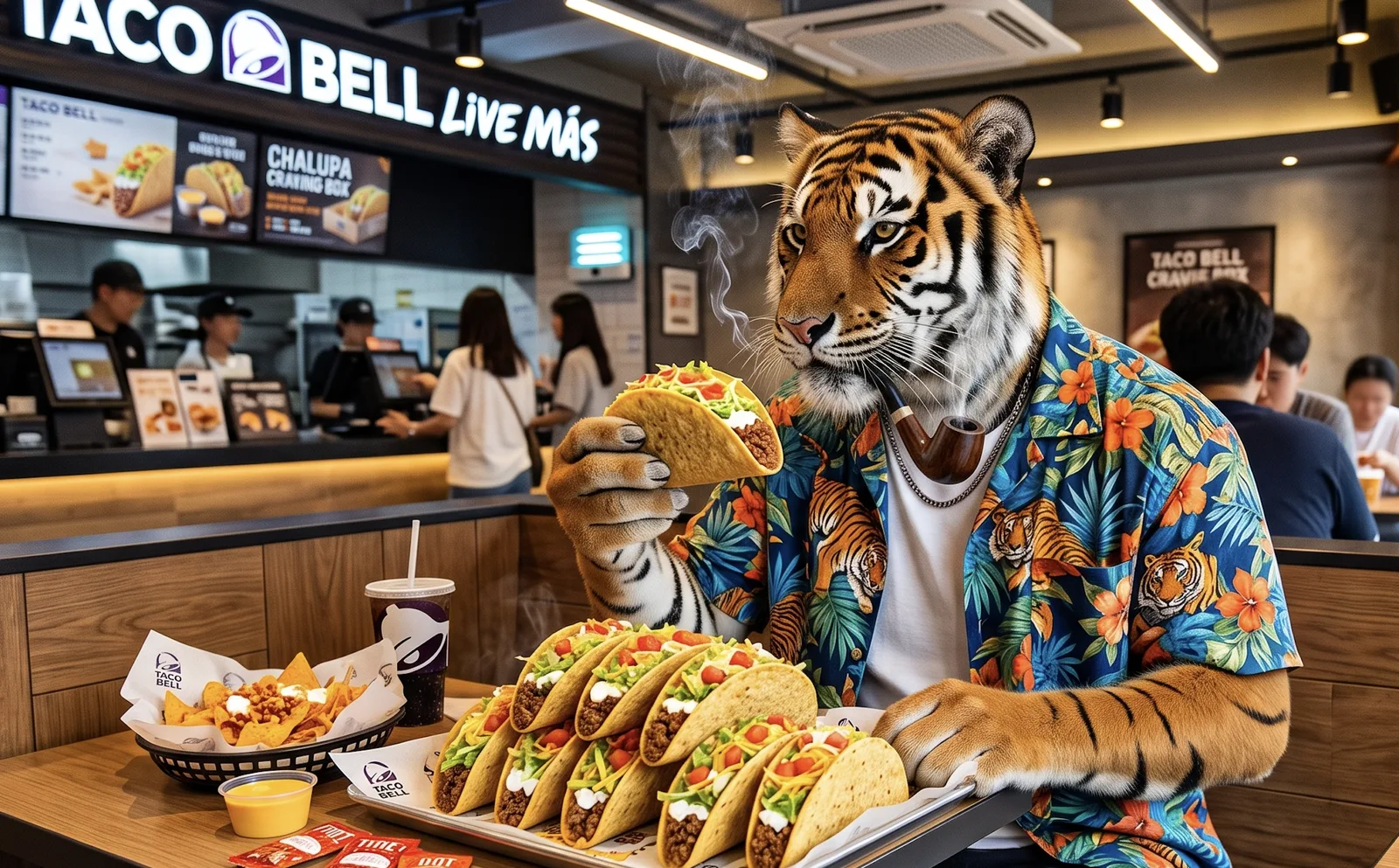
On Thursday the FDA finally announced what ten weeks of federal investigation had determined: the cyclosporiasis outbreak that has sickened 1,644 people and hospitalized 94 traces back to shredded iceberg lettuce served at Taco Bell locations in five states, from a single supplier.
If 10 weeks seems like a really long time to solve the explosive diarrhea mystery, that's because it is.
The joke was on The Daily Show instantly. Arby's had turned a competitor's parasite into a promotion, “free mac and cheese with your cheesesteak, for the lettuce-wary.” And the internet needed no time at all to surface Taco Bell's 2006 E. coli outbreak, which was also lettuce, because the culture keeps flawless provenance notes on a brand's failures (and none whatsoever on its food). Said another way, the same economic technology that can trace a Taco Bell consumer across four devices in a hundred milliseconds couldn't find a sketchy head of iceberg lettuce in under a fiscal quarter.
Shredded lettuce is provenance-destruction by design. Once it's shredded, all lettuce seems like the same lettuce. The supply chain was engineered not to keep receipts.
As a lover of Taco Bell myself, I found the cruel footnote to be that Taco Bell actually did the expensive, honorable thing and pulled the lettuce before the CDC called it out. But then, as crisis consultant Kate Finley put it, they undercut the courage “with a statement written by lawyers.” Her better line: “the punchline predates the parasites.” So Taco Bell wins the honorific, but still ends up covered in sh*t.
Takeaway: Liable lettuce came from a supplier nobody could find for ten weeks, precisely because the evidence itself was shredded so questions about the supply chain wouldn't be asked.
(Sources: FDA; CDC; Business Insider; Ad Age)
This Week's Red Thread: Provenance
Sometimes, provenance is a copy line — an RTB like “crafted with care”, “small batch”, or “farm to table.” The kind of claim that's supposed to sound like what it's describing, and not really verifiable, which was always sorta the point.
But this week: a hacker turned Suno's training corpus into an exhibit. The FDA turned Taco Bell's menu items into case numbers. Sotheby's turned 67 million years of safe-keeping into the most expensive souvenir of all time. And a $250 million movie sold out globally because everyone knew exactly how hard it was to make.
Over and over, it comes back to provenance.
In the best cases, it's the bones, the film stock, the box and papers. In the worst cases, its absence can become a crime scene.
No matter what they do or make, nearly every brand in America lives somewhere in between, where cheap opacity keeps you on the Tuesday shopping list right up until the week everyone starts asking where your lettuce came from. So the real question is which extreme you're playing toward, because the middle will never last forever.
I have a provenance claim of my own at the bottom of every edition of these Sunday Scaries, which I've always felt I needed to prove: “100% written by humans”.
But maybe I should settle for the peace of mind that comes from knowing I'm not causing anyone GI problems.
— NB