SUNDAY SCARIES: The Honor System
From Princeton to Cannes, we look at 4 institutions that just admitted the honor of their system was no longer legitimate.
1. Testing Fail
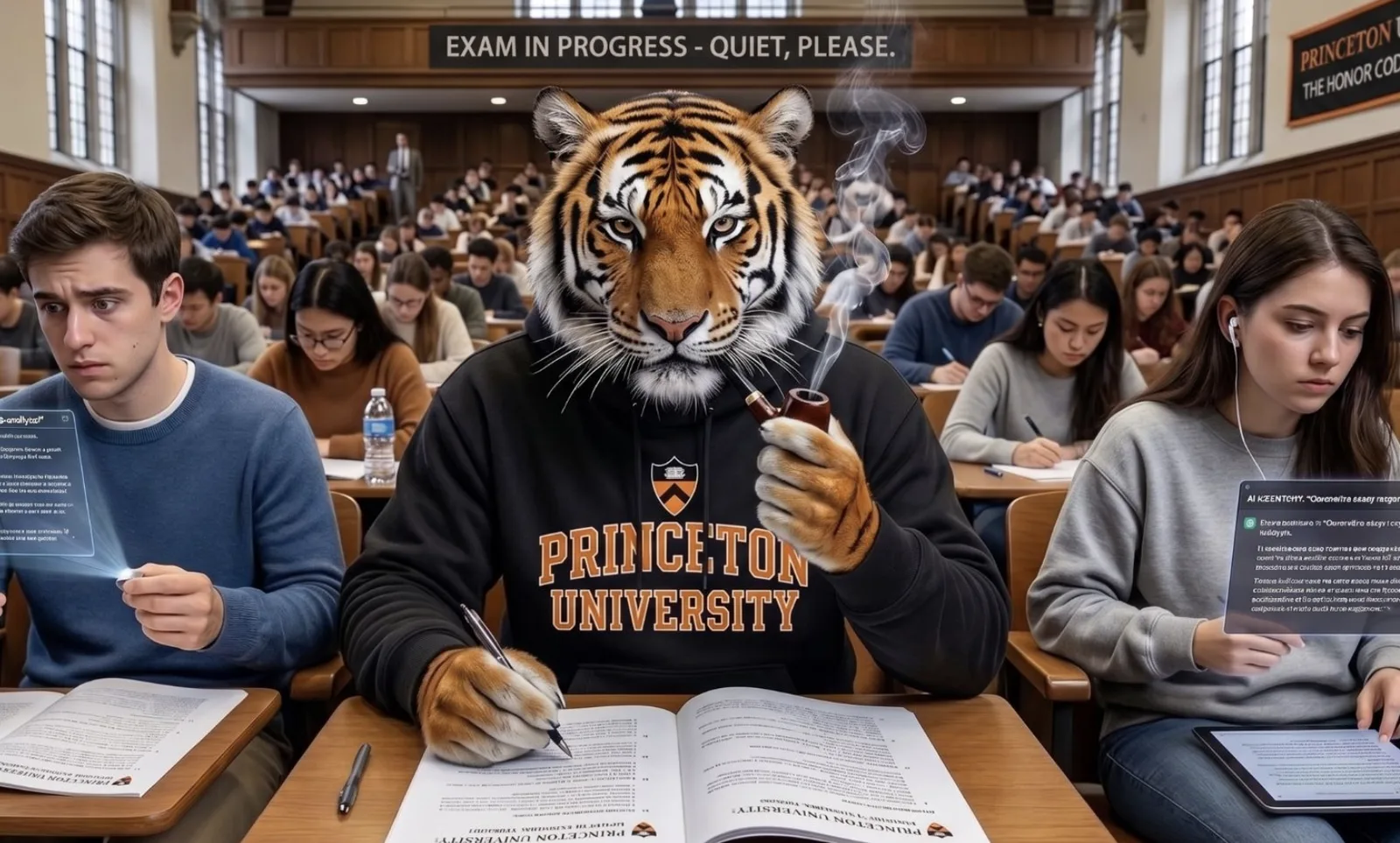
Princeton University faculty voted nearly unanimously on Monday to put proctors back in every exam room starting July 1, retiring an Honor Code in place since 1893. The numbers behind the vote: 30% of seniors admitted cheating in the Daily Princetonian's senior survey. 28% used ChatGPT on assignments where it was prohibited. 45% knew of a violation. Less than 1% ever reported anyone. A history professor sat in a campus coffee shop and watched students copy ChatGPT responses verbatim.
The Honor Code outlasted two world wars, mass media, the internet, and the smartphone. It did not last three and a half years against a chatbot.
The exam used to test what a student knew, backed by a system that tested who they were while they answered. Strip out the second part and the first becomes a copy-paste anyone can pass.
Takeaway: Princeton didn't bring back proctors to catch cheaters. They brought them back because the exam itself had stopped meaning anything.
(Sources: Inside Higher Ed; Daily Princetonian; The Atlantic)
2. Upfront Reveals Revealed
Upfront Week used to be the industry's annual BIG reveal: new shows unveiled live for all the people writing the checks. The reviews this year were unanimously unimpressed. Instead of big reveals, networks revealed the proof that they had the living human talent under contract. Disney brought Robert Downey Jr. Netflix announced its NFL deal would extend through 2030. Fox highlighted Tubi's existing reach while NBCUniversal padded two hours with song-and-dance numbers.
The Wrap's summary: most presentations focused on showcasing the talent these companies already have rather than building hype for new shows. DIRECTV ran an OOH campaign in Manhattan all week calling Upfronts itself “a week-long metaphor.”
The reveal got replaced with the receipt. The week used to ask what's coming. This year it answered we promise this celebrity is really in our programming.
Takeaway: Upfronts used to be about the excitement of what was coming. Now it's a notarized affidavit of what's already been done.
(Sources: Deadline; The Wrap, May 15; Axios; DIRECTV)
3. Photo Finish
For 180 years, a photograph was its own evidence.
Photos documented My Lai and the Moon Landing. It made Tiananmen Square immovable. It gave us images of Abraham Lincoln’s speeches and put Abu Ghraib in front of a country that wanted to look away. It survived air-brushers, doctored covers, and every tabloid that ever spliced a head onto someone else's body.
This week the AP, Reuters, and the New York Times continued their integration of Content Credentials, a cryptographic chain of custody attached to every image. Leica's $9,000 M11-P, Sony's Alpha 1 II, and Nikon's Z9 embed authentication chips in the body itself. Google's SynthID watermarks every Gemini and Imagen output. Insurance companies have started asking whether visual evidence is C2PA-signed before paying claims.
The medium that captured the horrors of every war and the proof of every scandal that brought down a president now requires a separate proof that it happened.
Takeaway: 180 years of photography kept us all honest. The replacement is a watermark.
(Sources: Content Authenticity Initiative / Adobe; Reuters Institute; Google DeepMind SynthID; AP NewsRoom 2026)
4. Awards Judgement
Cannes Lions were always the biggest prize in advertising. My own Cannes Lions and One Show Gold Pencil are the awards I hold most dear. It's the global creative industry's annual statement on the best work of the year, decided by twenty heavyweights in the south of France.
Last year's festival was marred by AI-manipulated case studies, unverifiable claims, and revoked trophies. Adweek reported Wednesday on the new Global Integrity Standards in place for 2026: human and AI fact-checking on every entry, stricter client sign-off, three-year bans for agencies caught submitting fake work, the right to withdraw awards at any stage. An 18-page Integrity Handbook was published in November. Adweek's headline from one industry source was that it's “burdensome but necessary.”
The award used to mean you had achieved something unique. Now the work has to certify itself before the award can consider it. And the judges aren't just there to judge excellence anymore, because they're also busy fact-checking the entries.
Takeaway: When the industry can no longer judge the best work without fact-checkers, the trophy is no longer the proof it once was.
(Sources: Adweek; Cannes Lions Integrity Handbook, November 2025)
This Week's Red Thread: Systematic Honor
In 1876, an editorial in The Princetonian argued against proctoring exams. Proctoring, the editor wrote, was “a means of bad moral education.” Treat students as presumptively honest and they would learn to behave that way. Treat them as dishonest and they would become so.
The argument held for 133 years.
We made a bargain, somewhere along the way, that the things we built our civic life around, what an education meant, what a photograph proved, what a peer's judgment certified, would be backed by something internal to the people doing them. Character. Witness. Judgment.
We took those things for granted because they were free.
Three and a half years of generative AI broke that bargain.
A 133-year-old honor code, a 180-year-old medium, a 72-year-old award. All of them outlasted world wars, the entire computing revolution, and the smartphone. None of them lasted three and a half years against a chatbot.
The kids who wrote that editorial in 1876 had figured something out we just unlearned:
You can change the testing. You can evolve the camera. You can fact-check the awards.
You can't rebuild the trust behind it all that they used to assume.
Without the truth of photos, history is debatable. The honor was what held us to it.
— NB