SUNDAY SCARIES: The Big Bluff
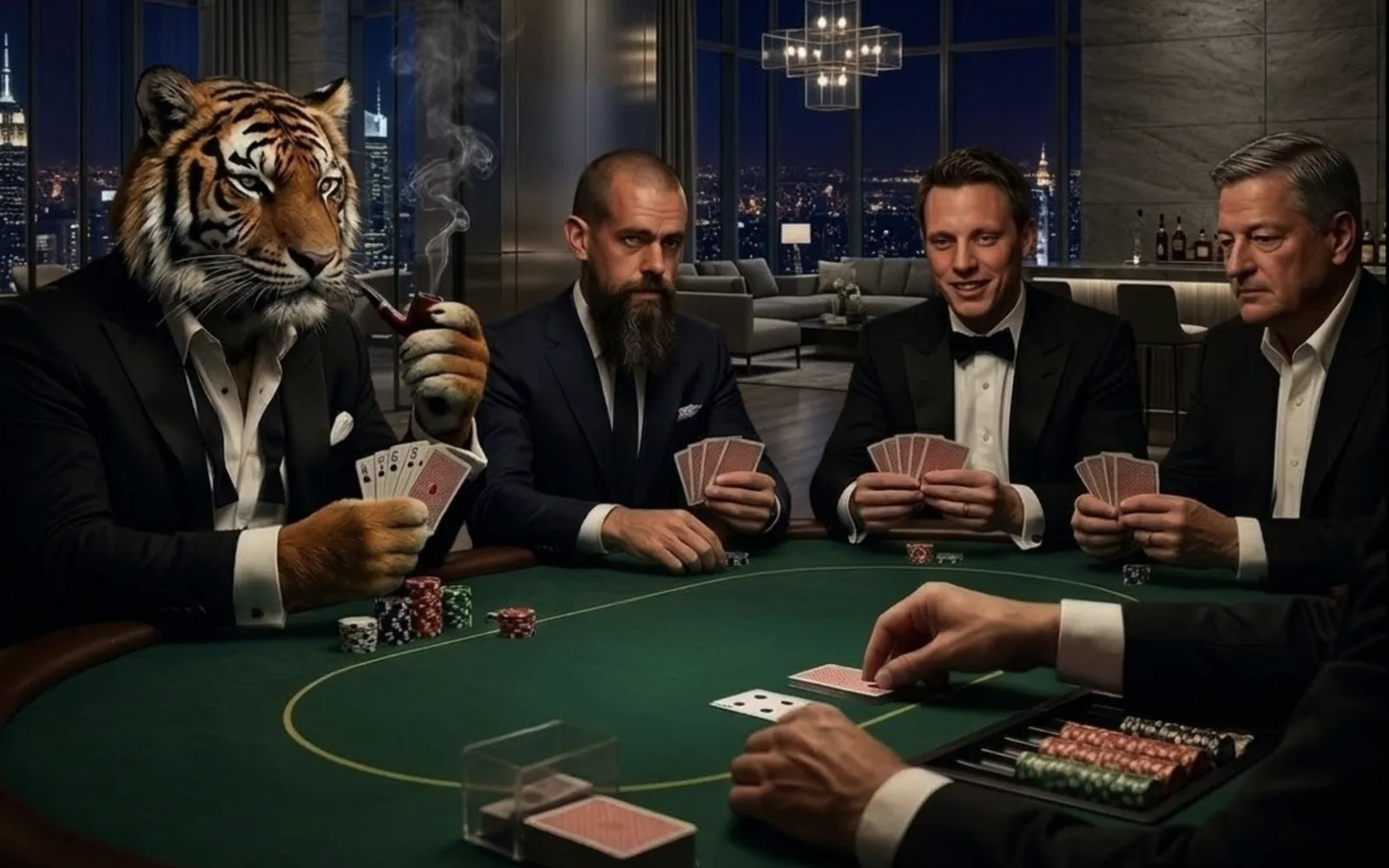
In poker, a bluff isn't exactly a lie. It's a story you tell the table about the cards you're holding, while knowing the real cards tell a different one. The best bluffs work when other players at the table want to believe them.
1. Dead Man's Hand
Block CEO — and extreme goatee devotee — Jack Dorsey cut nearly 40% of his company last week — 4,000 people. Dorsey told analysts it was because of the impending AI workforce changes and the stock jumped 24%.
But Block had already run major layoffs in 2024 and 2025. Between 2019 and 2023, the company ballooned from 4,000 to nearly 13,000 — a pandemic hiring binge that was always going to correct. Former head of comms, Aaron Zamost, wrote in the NYT that eliminated roles included policy and DEI positions. (Not jobs replaced by AI... jobs that are just gone). And Business Insider ran a piece about the amount of hasty retention bonuses being thrown around for high performers they didn't want to lose to competitors.
Days earlier, Anthropic published data mapping the gap between what AI can theoretically do and what people actually use it for. In computer and math roles, theoretical capability covers 94% of tasks. Actual usage: 33%. ChatGPT has 900 million weekly users. The fraction extracting real productivity value: only a quarter of one percent.
Takeaway: AI isn't ready to be the reason for what's happening. As another former Block employee Jason Karsh posted, "It's organizational bloat wearing an AI costume."
(Sources: Futurism; NY Times (Zamost); Anthropic Economic Index; CNN Business)
2. The River Card
Without the slightest smirk or glimmer of irony, WPP declared it is “no longer a holding company.” Revenue down 5.4%. Profit is down 71%. The plan: cut $677M, restructure around an AI platform called WPP Open. Same week, Omnicom announced $1B in labor cuts post-IPG merger.
S4 Chairman and all around bogeyman Martin Sorrell spent three decades building WPP through acquisition — buying agencies, keeping them separate, billing clients for the complexity between them. That complexity was both the product and the debt. Client losses, talent drain, a share price in decline long before anyone said “agentic marketing platform.”
Cutting to the present again, Cindy Rose was hired to restructure. The restructure was coming regardless of what you called it.
Takeaway: WPP declaring it's 'no longer a holding company' is like Philip Morris renaming itself Altria. The label may have changed, but the lung cancer is still the same.
(Sources: Marketing Dive; Adweek; B&T)
3. Opting Out of Reality
Netflix walked away from Warner Bros. Discovery and their stock popped 14%. They collected a $2.8 billion breakup fee — about 15% of their annual content budget — for deciding not to buy it. Claiming victory, the Ellison family concluded their scorched earth campaign to buy it for the indefensible sum of $111 billion.
Scott Galloway ran the math in his weekly newsletter: for the same price tag, one could buy Disney — theme parks, Marvel, Star Wars, ESPN. The Ellisons got HBO, CNN, $40B in debt, and a linear TV business shrinking faster than regulators can process the paperwork. (“Synergies is Latin for layoffs,” as Galloway put it. They've already cut 2,000 at Paramount.)
If you're keeping score, this is the seventh time Warner has been acquired since 1967. And every Warner acquisition follows the same script. Time Warner, 1990: crushing debt. AOL, 2001: $99B write-down. AT&T, 2018: sold at a 50% haircut four years later. Seven buyers. Same ending. Maybe Ted Sarandos looked at those numbers, pushed back from the table, and collected $2.8B on his way out of the casino.
Takeaway: When the biggest innovator in an industry folds and steps back from the table but gets paid billions to do it, history has shown that's the poker player to emulate.
(Sources: Galloway: No Mercy No Malice; CNBC; Bloomberg)
4. Showing Their Cards
Ahead of new creative director Demna Gvasalia's debut runway show, Gucci released AI-generated campaign images. “I think this [image] says 2026,” he said backstage. “I'm using things as a tool.”
Much of the industry spent the week debating whether luxury brands should use AI. And that's the wrong conversation. A house built on gold sheen and Italian craftsmanship used its marketing to signal it no longer values the thing its audience pays for. A bad photograph would have triggered the same instinct. The audience didn't react to the tool. They reacted to a brand that forgot why they chose it.
This happens constantly in marketing: when a sponsorship is the wrong fit, the brand blames the partner instead of the people who chose them. When a campaign message flops, the leadership cites a lack of influencers instead of a lack of strategy.
Takeaway: Gucci's images misfired and the conversation became about artificial intelligence — when the breach was about sacred brand truths.
(Sources: CNN Style; Dentsu Social Q4 Report; BBC)
This Week's Red Thread: "Narrative Debt"
I'm a terrible poker player, but even I know that the person bluffing always knows why they're lying. All the bluffers, WPP, Dorsey, the Ellisons, and Gucci knew exactly what they were doing and they did it anyway.
Because the bluff wasn't aimed at their audiences. It was aimed at the market. And right now, the stock market seems to be the easiest audience to fool — it wants to believe in AI. Give it the right soundbite and it will applaud the very things it should be questioning.
But the market isn't the audience that keeps brands alive.
Customers are. Employees are.
The people who experience your product instead of your stock price don't hear the earnings call. But they feel the layoff. And they see the AI image where a craftsperson used to be. And they will notice when the brand promise changes.
Four companies told the market one story last week, while their audiences were seeing a different one. That gap has a name in poker. In branding, it doesn't have a name yet.
But I'm going to call it, “Narrative Debt”
Because it's the thing that kills companies — not all at once, but slowly, ...as the people who actually pay start to feel like the story was never meant for them.
— NB