SUNDAY SCARIES: More Mascots!
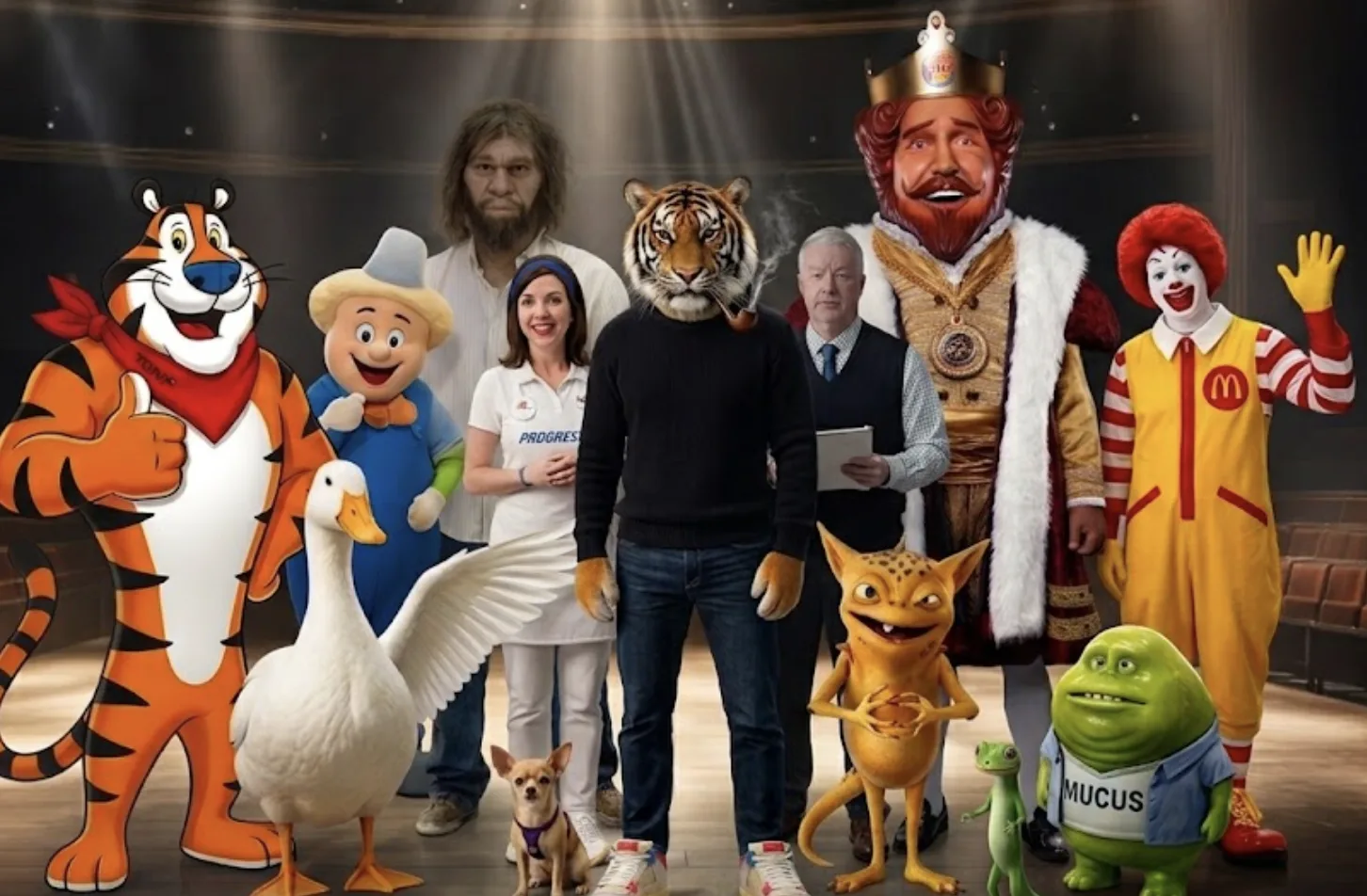
Apparently, ’tis the season for hot takes on mascots.
I am nothing if not trendy, so we’ll spend this week looking at the fluffy, funny, flawed, and famous mascots that Americans love and the ones they don’t.
Most of all, I’ll be looking at when and why they worked. When they didn’t. And whether it was all worth it in the end.
1. Tony Is an Endangered Species
Most food companies treat their mascots with the permanence that a beachside restaurant treats their summer waitstaff.
In 1952 Leo Burnett introduced Tony the Tiger on a box of Kellogg’s cereal alongside Katy the Kangaroo, Elmo the Elephant and Newt the Gnu. But within a year the other three had been let go and Tony hangs on.
Burger King retired the King in 2011, brought him back, even paid $1 million to put him in Floyd Mayweather’s entourage, and then fired him for good in an Oscars ad this March, with the company blaming his “creepy factor.”
On October 1, McDonald’s Japan finally changed the mascot’s official name to Ronald, after fifty-five years of calling him Donald McDonald. The first Ronald was Willard Scott, who later became the weatherman on the Today show. McDonald’s fired him before the 1966 Macy’s parade because of his “husky figure.”
And Taco Bell’s chihuahua, whose real name was Gidget, sold 13 million plush toys during a quarter when the restaurants’ same-store sales fell 6%, which is like a waitress getting a big cash tip on the side while the table runs out on the bill.
Takeaway: In food, being famous has never been enough to keep the job.
(Sources: Wikipedia; Restaurant Dive, March 2026; SoraNews24, October 3, 2026; The Takeout; Seattle Times, July 20, 2000)
2. Digger and the Villains
Medicine uses mascots for the things nobody wants to look at up close.
In the early 2000s Pfizer gave depression the shape of a sad little blob for Zoloft, drawn by Patrick Smith, who also directed MTV’s Daria, and Zoloft sales peaked at $3.36 billion in 2004.
In 2003 Deutsch turned the fungus behind toenail infections into a monster named Digger the Dermatophyte for Lamisil, and a year later Mucinex turned mucus itself into a character. Ten years after that, McCann called Mr. Mucus “one of the most recognized but least-liked ad characters in the world,” but the brand kept him.
The FDA was worried enough that cartoon characters might make prescription drugs seem safer than they are that it ran a study on them. The cartoons made no difference to how well viewers remembered the risks, while viewers liked the animated ads less than the live-action ones.
Takeaway: In medicine the mascot plays the disease, which is the role where being disliked is the job.
(Sources: MEL Magazine, 2021; PharmaVoice, August 2004; FiercePharma, 2014; FDA and Journal of Advertising Research, 2021)
3. Mascots Mandatory
It’s not a coincidence that insurance is the industry that leans more heavily on mascots than any other. Insurance is a product nobody wants to think about until the day they have to and most people only think to shop for it when the price goes up.
So an insurance mascot has a simple job: be the name you remember on that day. The industry seems to know it. In a 2023 study of finance advertising, most insurers used characters, the banks used none, and eight of the ten best-performing ads were insurance.
That sentiment is what Warren Buffett put plainly in his 2016 letter: “When insurance prices increase, people shop more. And when they shop, GEICO wins.”
Before the duck, Aflac had already spent $100 million on advertising, and according to the agency that created the duck, “no one had ever heard of them.” In his first two weeks on air in 2000, the Aflac duck brought the company more sales leads than all of 1998 and 1999 combined.
The GEICO gecko may be small, but the ads are effective. GEICO’s share of the auto market went from 2.5% in 1995 to about 12% by 2016, and the gecko ran most of that time. And GEICO set the bar high for continuing to reinvent the same wheel over and over again with absolute glee. Their Cavemen were so popular that ABC gave them their own sitcom.
Progressive’s original “Flo” seems to be basically retired now, but she has offshoot characters from her fictitious team and they each have their own storylines.
And Progressive’s Dr. Rick, who coaches young homeowners out of turning into their parents, is, in this writer’s opinion, some of the best comedy on television right now.
Takeaway: When people never think about your product, a mascot is how you make sure they think of you when the time comes.
(Sources: Berkshire Hathaway 2016 shareholder letter; Zappi, November 2023; Wharton; Encyclopedia.com; Wikipedia)
4. Stuck With a Duck
The same reason insurance needs a mascot is the reason a mascot can only do so much: a character people remember is still selling a product they’d rather not understand.
In 2003, three years into the duck, 60% of people didn’t know what Aflac sold, and in 2019 the company launched a campaign called “Aflac Isn’t” because consumers “don’t understand Aflac and how our products can help them, yet they think they do.”
In March 2011 Aflac fired Gilbert Gottfried, the duck’s voice since the beginning, over jokes about the tsunami in Japan, which at the time was 75% of Aflac’s business. (Ten years earlier, Microsoft had hired Gottfried for a campaign mocking Clippy as the most annoying thing in computer history.)
The Cavemen were a commercial juggernaut, but their sitcom was canceled after thirteen episodes.
And Dr. Rick has 54% awareness against 95% for Flo. It’s just because he’s the straight man; the actors playing the parents carry the humor, leaving Progressive’s funniest campaign with its least-known character.
Takeaway: A great mascot can make you remember an insurance company and still leave you guessing what it does.
(Sources: Encyclopedia.com; Aflac, January 2019; Christian Science Monitor, March 15, 2011; Techdirt, April 2001; Wikipedia; Harris Poll for Ad Age, January 2022)
This Week’s Red Thread: The Art of Happy Accidents
At the 1894 Lyon exposition, Édouard Michelin looked at a stack of tires and saw a man. The artist who drew him for the 1898 poster loosely reworked a sketch a Munich brewery had turned down, (which is why the first Michelin Man is still raising a goblet that presumably would have contained beer). In 2000 the Financial Times voted him the greatest logo in history.
The Energizer Bunny started in 1988 as a parody of Duracell’s drumming bunny, which had been around since 1973, at a moment when Duracell’s US trademark on it had lapsed. In a 2019 survey 83.6% of Americans recognized Energizer’s bunny against 11% for the original.
According to the agency, the duck came from a frustrated creative walking around the block at lunch repeating “Aflac” over and over until it started to sound like a quack. That became the mascot idea and Aflac’s brand recognition went from 11% to 94%.
The gecko came from a focus group that couldn’t pronounce GEICO, and according to a former marketer, it only survived the first campaign because the CEO’s wife liked it.
This summer Liberty Mutual staged its own accident by making a scripted outtake of an actor who couldn’t say “Liberty” into “Liberty Biberty”, into a mascot and campaign, which it’s putting its marketing money behind.
Rejected brewery sketch. Expired trademark. Frustrated creative walking around the block. People who couldn’t pronounce the company’s name. And I have not even begun to scratch the mascot surface. I could write Sunday Scaries about different mascots for about a year.
For something advertisers spend billions trying to manufacture, legendary memorability has no formula. And it has a somewhat unexpected habit of arriving sideways. There’s no trick to knowing exactly where it will come from. But the key is knowing what you’re looking at when it gets there. Because, like Coke’s Santa, it can become bigger than any one brand or company or even country.
(While it’s loosely based on the poem known as “The Night Before Christmas”, Coca-Cola’s depiction of the rosy cheeked Santa Claus became the pseudo-official visual of a mythical figure across the globe.)
But by my back-of-the-coffee-sleeve math, advertisers have spent about $3 trillion on mascots over the last hundred years and made back about $3.5 trillion in additional profit they wouldn’t have had otherwise. Which works out to paying about 86 cents for every dollar.
And that’s all that matters.
— NB