
SUNDAY SCARIES: Michelotti the Idea Person
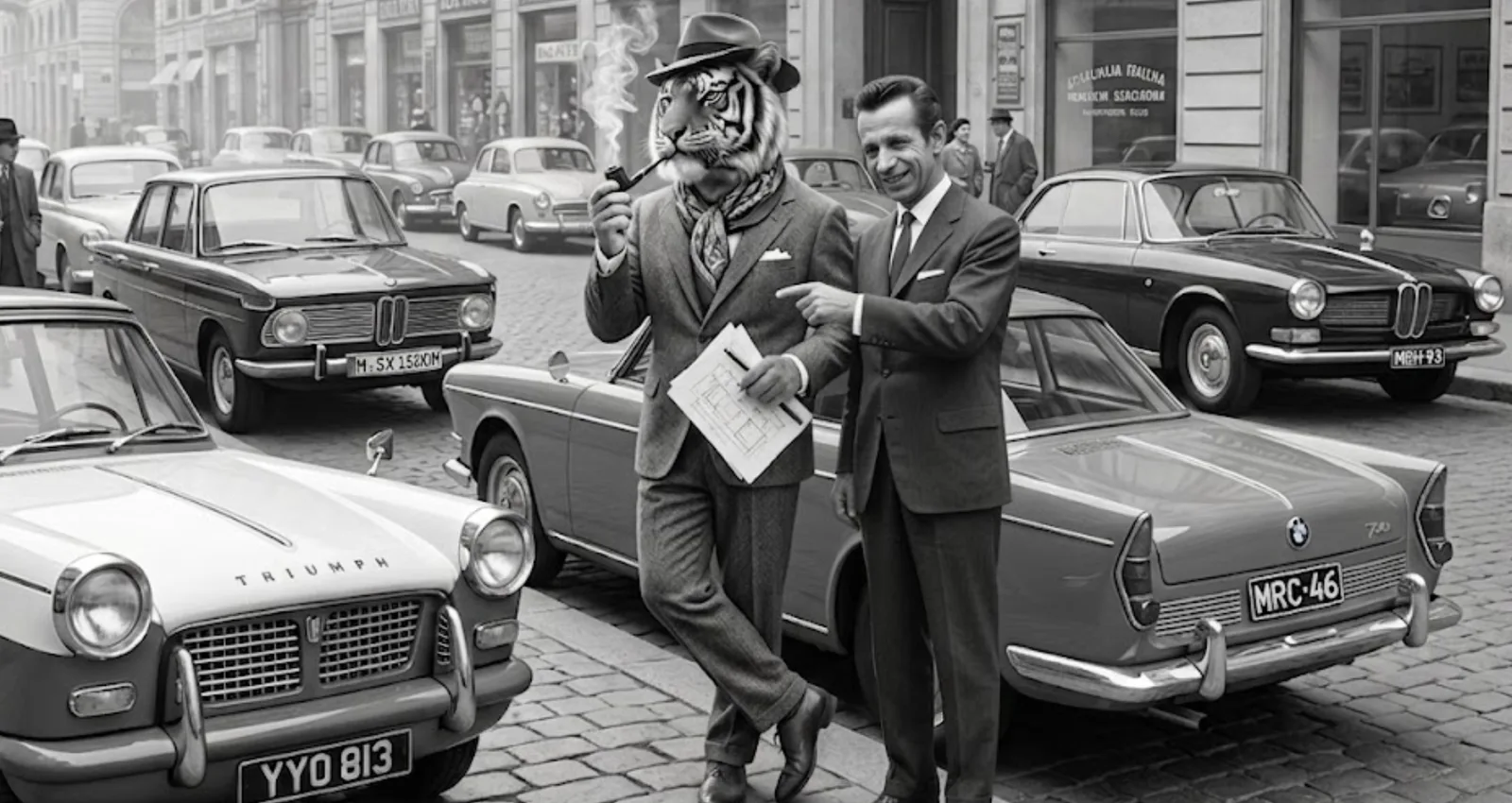
AKA: The Greatest Car Designer You’ve Never Heard Of
Since the last weekend in August is a stretch of the year when most of the ad business is quiet, I am spending this Sunday selfishly writing about a hero of mine who designed cars in the middle of the 20th century: Giovanni Michelotti.
His is not a name like Ferdinand Porsche, Bugatti, DeLorean or Carroll Shelby. It’s not even like a Koenigsegg, Pagani, or de Tomaso. But he changed the history of automobile design with his creations by giving people more light at a time when others were wrapping drivers in steel and aluminum. Michelotti designed cars with more glass and thinner pillars that you could see out of, when everything else on the road was getting heavier and darker. Which is a decent metaphor for the man himself, who was more interested in letting the attention stay on the car’s success, and not on him.
While designers like Scaglietti and Pininfarina had their names as marques that adorned the Ferraris they bodied, Michelotti was more like a journeyman creative director. He was dedicated to making the very best version of something that had someone else’s name on it. And when the cars that the creative designed made waves, they were always for someone else.
1. Michelotti at Ferrari: Racecars That All Said “Vignale”
Two Sundays ago at the Concours d’Elegance at Pebble Beach, a 1954 Ferrari 375 America designed by the Vignale studio was nominated for Best of Show. While the Vignale name was toasted, that Ferrari 375 was actually drawn by Giovanni Michelotti.
Alfredo Vignale could shape a car body out of flat aluminum with a hammer and his own hands, and he had a small shop in Turin, Italy. In 1950, Michelotti was twenty-eight and had just set up his own shop nearby as an independent car designer, and he would draw for anybody who asked. Between them, over about four years, they made a hundred and fifty-five Ferraris, but only Vignale’s name was attached to them.
These were famous cars in their own right. The winner of the 1951 Mille Miglia was behind the wheel of a Ferrari 340 America that was designed by Michelotti and built by Vignale. (Legend has it that it crashed near Ravenna, got the body hammered back into shape on the side of the road, and still finished twenty minutes ahead of the next car.) The Mille Miglias of 1952 and 1953 were also won by bodies designed by Michelotti, but in the history of the company, all those winning Ferraris are credited to Vignale.
Even before those last two wins, the famous marriage between Enzo Ferrari and Battista Farina had already begun (after they each refused to meet until they found a restaurant exactly halfway between their two factories) and Pininfarina designed Ferraris for the next sixty years.
Takeaway: Victories in the most important race in Italy gave Michelotti assurance and credibility but not his name in lights. Those winning cars will always be known as Ferrari “Vignale” berlinettas.
(Sources: Ferrari.com; Marcel Massini, Ferrari by Vignale; RM Sotheby’s and Gooding catalogues; Pebble Beach Concours d’Elegance, August 2026)
2. Michelotti at Triumph: Cars That Came in Pieces
After Ferrari, Michelotti became an international “have pencil - will draw” designer and found work in England when, in the mid 1950s, Triumph suddenly lost their ability to make Triumphs. The factory that pressed Triumph’s car bodies had been bought by the biggest car company in Britain (the inventively named BMC, or British Motor Corporation) and the petty rivals had no intention of assisting Triumph in any way. Modern cars were no longer hammered out of aluminum by hand; they meant one enormous welded steel shell, and a shell needs presses the size of a house, and Triumph had neither.
Harry Webster was Triumph’s chief engineer at the time. With no money to build their own factory press, he decided to go back to a separate chassis, which required that every panel, roof and piece be bolted onto it separately. Small workshops each made one piece, and the pieces got screwed together at the factory.
So that was the brief that Michelotti got from Triumph. From those restrictions, he drew the Triumph Herald, a small upright car with a crease running down the length of it and almost nothing above the waistline except the window. I have never had the pleasure, but apparently when you sit in a Herald there is sky in every direction. Because nothing was welded, it was like a Lego car; the same chassis could be a saloon, a coupé, and a convertible, and because there was nothing crowding the front wheels, you can spin one in a normal street without reversing. Over half a million Heralds were built and the Brits were more than happy to have an Italian as their secret weapon.
(When that same Herald frame was shortened, it became the legendary Triumph Spitfire, a truly badass car which was made for eighteen years, and Michelotti’s son and family claim the Spitfire was his father’s favorite car of all.)
Triumph asked him for a sports car, twice, and killed both for different reasons. Then, like a typical client, they asked if he could give them “something in between the two” dead ones, and what Michelotti handed them was the Triumph TR4.
The TR4 is fiercely wide and low, with the grille set back into the nose and a line along the shoulder running clean from the headlamp to the tail, and a bulge in the hood because of the carburetors underneath it. But under that new shape was the old car, sitting on the same chassis and running the same engine as the TR3 it replaced.
Takeaway: Triumph asked him for a car that could be built in pieces, and he gave them the car designs that united the country.
(Sources: Grace’s Guide; Hagerty UK; National Motor Museum, Beaulieu; Motor Sport, September 1961; Club Triumph; TR Register)
3. Michelotti at Nissan: Sixty Cars Made by Hand in Tokyo
In 1960, Japan made mostly small motorcycles and sensible things and had almost no designers who considered a car as an object that anybody would want for its own sake. But a company called Prince decided it wanted one, and hired Michelotti.
Michelotti drew them the Skyline Sport, a quirky-looking car which appeared at the Turin show. Sparing no expense, the bodies were built by hand in Japan, by craftsmen brought over from Italy to teach them how.
Around sixty cars were made that way: with Italian and Japanese guys working side by side, hammering out the bodies of what would become Japan’s racing pedigree. Because they were hand-built and massively expensive, (a single car cost more than a standard house in Japan at the time) they were completely unsustainable as mass-production vehicles. Prince merged with Nissan, and the Sport Coupe and Convertible did not pass down their body styles or physical parts to future generations.
Instead, they established the Skyline’s identity as a premium, performance-oriented machine, laying the psychological groundwork for the legendary sports cars that followed. The same plainspoken Skyline name is still on cars today, and its lineage runs directly to the Nissan GT-R.
Takeaway: Michelotti designed a car, which was partially responsible for giving a country a new way of thinking about cars in general.
(Sources: Nissan Global Heritage Collection; Curbside Classic)
4. Michelotti at BMW: “Assistance from the Famous Italian Designer”
At the end of the fifties, BMW was not a car company that would claim to be “The Ultimate Driving Machine.” In December of 1959, it came within a shareholder vote of being sold to Daimler-Benz. Their main car was the Isetta, a soap bubble with a single door at the front that opened like a refrigerator and would look small next to a golf cart. Then there was the 600, which was the same visual joke stretched to fit four, (if your family happened to all be amputees.)
They also made a pair of gorgeous V8s, the 503 coupé and the 507 roadster, but they were priced so far out of reach that almost nobody bought them. But they had nothing in the middle for people, and no idea what belonged there. Michelotti was hired off the books and designed a car for them that fit in all the right ways.
The 700 is the first BMW that actually looks like a BMW, and the Germans couldn’t get enough. Within a year the 700 accounted for 58% of the company’s revenue. Which is why many people claim the 700 is the only reason there is still a BMW.
Two years later Michelotti gave them the 1500, which is arguably one of the best-looking cars made in the 1960s. BMW called the range the Neue Klasse, the new class, and it began the lineage that made BMW what it now is. After that came the 2000, the 2002, and the 3-series that set the bar for performance sedans.
But the history remains German, according to BMW. The company archive tells the story of who designed it in a single sentence. “To design the Neue Klasse, Wilhelm Hofmeister, the young chief designer of BMW, received assistance from the famous Italian designer Giovanni Michelotti.”
Takeaway: Sixty-five years later, the designer whose car is widely credited with saving BMW is credited only as an Italian guy who assisted the German wunderkind.
(Sources: BMW Group press archive; BMW Group Classic; Auto Bild Klassik; bmwgroup.com/neue-klasse; BMW Group press releases)
This Week’s Red Thread: Somebody Else’s Brand
A few weeks ago, my brother sent me a picture of a proper green Triumph Spitfire, a Michelotti triumph in every sense. And the car itself was draped in typical British pride, with a union jack sticker, an old UK license plate under the NY State one, etc. He said it belonged to some guy at the event he was attending, and he knew without asking that the guy was not only an idiotic anglophile but was probably wearing a Triumph hat or scarf just hoping people would ask him about it.
But I got pleasure knowing that the anglophile was driving a great British car that an Italian guy designed. Not because he was a jackass, but because all Michelotti would care about was the success of the car. As it was on the nearly 1,200 other designs he put into production for manufacturers around the world, Michelotti’s hand was invisible.
While I’m not remotely arrogant or delusional enough to compare myself to Michelotti, the feeling is the same as hearing someone discuss a campaign that I made or even just a commercial I wrote and not have any idea who typed the punchline in the script. I’m just happy it made a mark.
Which is a strange thing to admit in a business that keeps score the way ours does. Big name clients, credited work, awards, the arguments about whose idea it actually was. All of that is real and I have wanted my name on things plenty of times. The old Italian design studios wanted it too, which is why they put the family name on the badge, and every one of them eventually sold that name to somebody else.
There is a thing people say about creatives in this business, usually while explaining why somebody is not getting promoted, which is that they are just an idea person. Michelotti was just an idea person. He drew, and other people welded and stamped and budgeted and badged and sold, and most of those companies are gone now, or absorbed, or owned from somewhere else, and the ideas are still out on the road.
He kept a studio of his own in Turin for thirty years, with a workshop and craftsmen and his name over the door. His name never made it onto the cars that actually sold. His son Edgardo ran the studio for eleven years after he died and closed it in 1991, and what survives is an archive Edgardo keeps himself, six thousand drawings and twenty thousand photographs. But the proof of what Michelotti created is in the modern cars we see today. The bright cabins and slim pillars and glass where there used to be steel can be traced to him, though you’d never know it.
If you’re a creative director, at some point in your career somebody will eventually describe your work back to you and get the author wrong, and that’s why the only question worth anything is whether they described it accurately.
And why I would never have named The Nuance Collective the Nick Bayne Collective.
— NB