SUNDAY SCARIES: I Approve This Message!
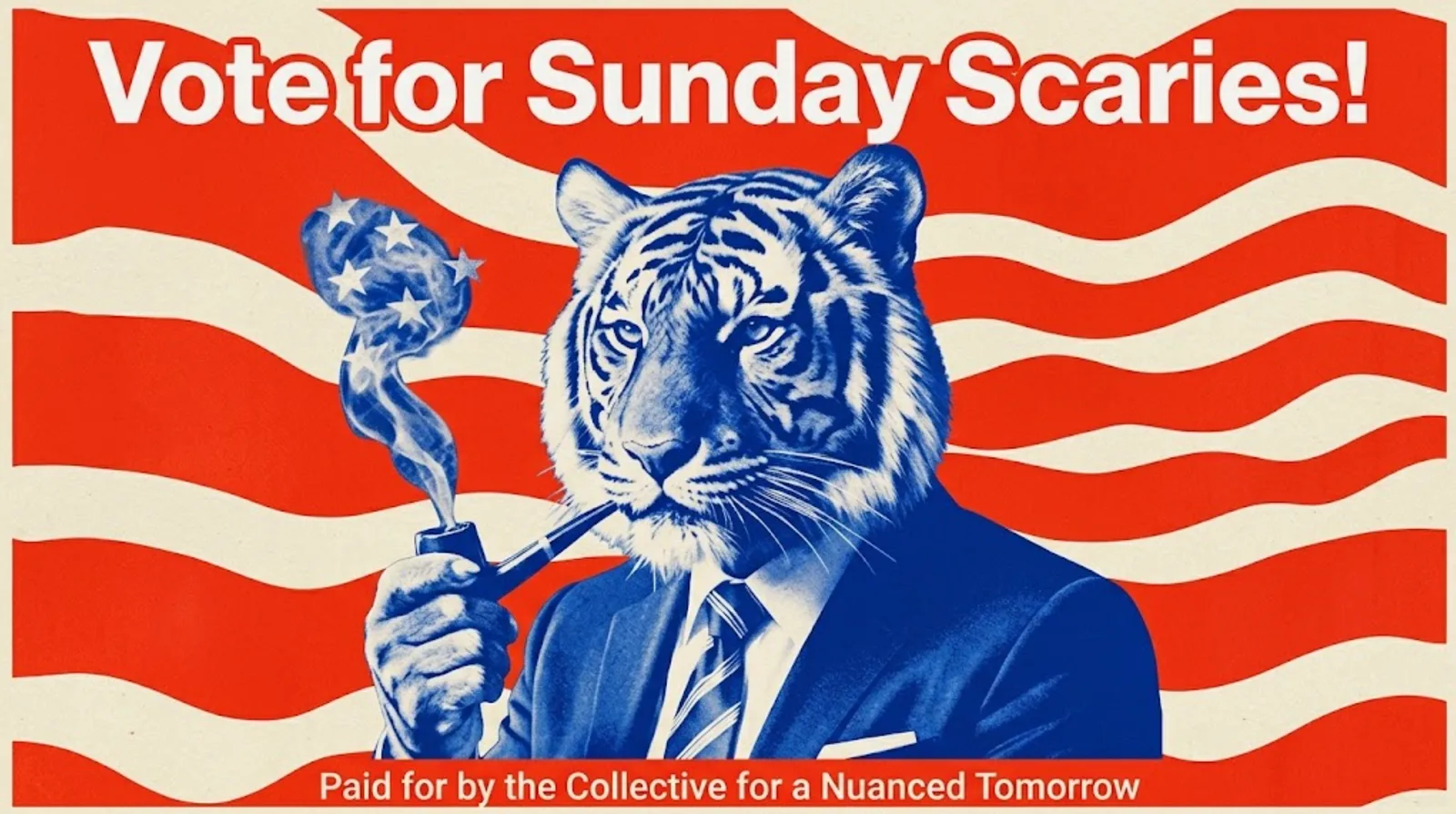
“I approve this message” is the most repeated sentence in American advertising every election cycle, and it only exists because Congress wrote it into the legendary McCain-Feingold bill in 2002, on the theory that candidates would run fewer nasty ads if they had to put their own face on them. Twenty-four years later campaign advertising for just this all important midterm election is going to surpass $11.6 Billion and the nasty and misleading ads are everywhere. So, this week, we’re looking at who is behind the largest purchase of political ads in US history.
Before we do, I’ll begin by saying: this week’s Sunday Scaries is paid for by Nick Bayne; it is not authorized by any candidate or candidate’s committee, and the views in this edition are mine alone, and not those of The Nuance Collective or anyone we work with.
1. “Paid for by the U.S. Government”
If you’ve watched any football, Fox News, or CNN or even just Dancing with the Stars since September 23rd, you’ve probably seen at least one of the “Patriotic Ads.” The spots are starring the president as the hero, with very partisan titles like “King of the Jungle” and “Final Battle,” and yet there’s a surprising tag at the end that says they were paid for by the U.S. Government.
Sure enough, it’s because the money that bought them came from the Dept. of Homeland Security. The White House budget office moved $20 million into a Customs and Border Protection account for “commemorative events,” and then handed a $20 million contract to a Maryland agency called LMD. More than $12 million of airtime has run so far, according to AdImpact. One of the spots, “God Made Trump” borrows Paul Harvey’s “So God Made a Farmer,” which most people in our industry remember as Ram’s Super Bowl spot from 2013.
FCC chairman, Brendan Carr, claimed they were like any “normal PSA,” with a straight face and the White House claimed plenty of presidents have done PSAs, though the experts point out the detail that a real PSA is usually actually a “service” to the “public” and sends you to a government program.
But the pushback was swift and came from both parties; even North Carolina Senator Tillis compared the whole thing to the playbook of Viktor Orbán. On Monday Trump conceded on Truth Social that he would pay for the ads “myself, and with money I raised for MAGA, Inc.,” his super PAC. Yet MAGA Inc. itself has been the subject of a Campaign Legal Center complaint over whether he himself controls its money, something federal law doesn’t allow an officeholder to do. The spots kept running and still had the government tag for two more days, and when he was asked about paying back the $12 million that had already aired, he said, “we’ll decide.”
Receipts: The conflict of interest is hard to overstate, and it’s certainly not fixed by sending the bill to a super PAC who is already the subject of a federal complaint.
(Sources: AP; New York Times; TheWrap; Newsweek; PBS NewsHour; Campaign Legal Center)
2. “Paid for by the NRSC… (and AI Generated).”
Anyone who has ever made a commercial with any type of claim, whether it’s CPG, Pharma, Financial, or even just for a big retail sale, knows the fight over the super. The fine print must be big enough to read and on screen long enough to read it, and the VO is not allowed to sound like an auctioneer at a livestock market.
In March, the National Republican Senatorial Committee ran an 85-second ad where a completely AI generated version of James Talarico, now the Democratic Senate nominee in Texas, reads his real old tweets back to the camera and adds commentary he never said (“oh, this one is so touching”). The words “AI GENERATED” show up in small type in the bottom right corner for about three seconds, come back even smaller and fainter for more than a minute while the fake Talarico talks, then return slightly larger and darker for the last five seconds.
The Wesleyan Media Project has tracked $80 million spent on almost 170 AI-generated political ads this year, and 69% of them carry no AI disclaimer at all. There’s no federal rule, and about thirty states now have their own laws on election deepfakes, but when the researchers compared them, 29% of AI ads carried a disclaimer in states that require one and 32% in states that don’t. The laws, in their words, have “very little relationship” to what ends up on screen.
Both parties are using AI, though nowhere near equally: Republican sponsors account for about 80% of the AI ads Wesleyan found and Democratic sponsors about 11%, and the best-known example on the left, Gavin Newsom’s AI videos of Trump in handcuffs, are posted on his personal X account with no paid placement behind them.
Receipts: Putting words in a real person’s mouth is clearly deception and including a label designed to be unreadable only gives the deception an alibi.
(Sources: CNN; Wesleyan Media Project; AP; The Conversation via Fortune; The Hill)
3. “Paid for by the AI Industry”
AI companies love telling us what their products are about to do to our jobs, our schools and the electrical grid, so you’d think the ads they pay for in an election year would bring it up at least once. The New York Times went and counted. Four super PACs the Times describes as aligned with OpenAI and Anthropic have spent $55.7 million on the midterms, nearly all of it in primaries for safe seats, and of the 95 ads the Times reviewed, not one mentions a data center and only seven mention AI or an AI company at all. Most of the rest run on ordinary campaign fare like crime, guns and immigration. One ad for Alabama congressman Barry Moore runs “CHAMPION AMERICAN INNOVATION” over footage of firefighters, the kind of headline and stock photo pairing that usually gets caught in the first internal review. In Texas, two ads from the same Anthropic-aligned network praise two House candidates for opposite positions on immigration.
To be precise about “aligned,” neither company gave directly to these super PACs. The OpenAI side is largely funded by personal money from Marc Andreessen, Ben Horowitz, and OpenAI’s president Greg Brockman and his wife (and the Times has since reported that Brockman has no plans to give the second half of his pledge). The Anthropic side runs through a nonprofit Anthropic has given $40 million, which it says can’t go toward candidates, and the network has also taken personal checks from people who work there.
(And in the spirit of this week’s disclaimer, the robots that proofread this newsletter are made by one of these companies.)
Receipts: Spending $55.7 million to choose the lawmakers who will regulate you, in ads that hide what you make, is nothing new. But they’re acting like routing the money through personal checks and nonprofits somehow makes it cleaner.
(Sources: New York Times; Anthropic; FEC filings via Transformer)
4. “Paid for by Holy Cannoli”
That $11.6 billion would put this midterm ahead of the $11.2 billion spent in 2024, when there was a presidential race on the ballot, and about 23% of it is going to streaming, the fastest growing channel and, like the rest of digital, one with no public political file. Over the summer Nexstar, Sinclair and Gray all told their investors that campaigns were partly to blame for softer sales to regular advertisers, crowding them off the airtime, and broadcasters told analysts at Gabelli that the crowding, which used to start in October, now starts around Labor Day.
A rule from 1971 makes it worse for anyone who isn’t a candidate. In the sixty days before a general election, candidates are entitled to a station’s lowest rate, and everybody else, super PACs included, has always paid whatever the market will bear (a Supreme Court order in September may let some of them in on the candidate rate).
In Portland, Maine, Susan Collins’s campaign paid WMTW $2,200 for a thirty-second spot during Wheel of Fortune, and Pine Tree Results PAC, a super PAC supporting her, paid $10,000 for the same thirty seconds. Up the road in Bangor, outside groups paid as much as $7,500 for a spot in WABI’s six o’clock news that went for $3,000 in 2024, and Holy Cannoli, a bakery in Waterville, says the station is limiting its spots for the forty days leading up to Election Day and will make it up to them around Thanksgiving and Christmas. Every brand reading this is putting its holiday plan into market right now, bidding for the same inventory against buyers spending other people’s money on a deadline of November 3rd.
Receipts: Unlimited outside money is paying four and a half times the going rate for local airtime, and the businesses covering the difference, like a bakery in Waterville, didn’t get a vote.
(Sources: AdImpact; TheDesk; NewscastStudio; Gabelli Funds; OpenSecrets via AlterNet; Bangor Daily News)
This Week’s Red Thread: Make the Logo Bigger
For most of my career, the brand side of this business has been obsessed with attribution, with multi-touch models and incrementality studies and weekly arguments about which thing gets credit for which sale.
Political advertising, in the richest year it has ever had, spent a lot of its money and most of its creativity going the other way, effectively masking the people behind what viewers are seeing and hearing.
The oldest joke in advertising is a note every creative has gotten from every client since the first print ads were painted on cave walls: “make the logo bigger.”
We laugh about it, but the logo at the end of a commercial is the brand’s own “paid for by,” and in more than twenty years, I’ve never had a client ask me to make it smaller. Brands sign everything they make, and then they have to stand behind it.
In 2009 the FTC made Kellogg stop telling parents that Frosted Mini-Wheats were “clinically shown to improve kids’ attentiveness by nearly 20%,” because in Kellogg’s own study only about one kid in nine improved that much. Every brand reading this lives under rules like that.
In our industry, every claim has to be backed up, paid endorsements have to be disclosed, and if you fake a competitor saying something he never said, you’ll be hearing from his lawyers by the end of the week. Political ads answer to none of it, because they’re protected political speech, and a station isn’t even allowed to censor a candidate’s own ad for saying something false.
The government tag, the firefighters, and the AI Talarico ad made it to air, but a cereal couldn’t get away with any of it.
In 2010, Citizens United decided that corporations and unions could spend as much as they wanted on elections, and within two months a federal appeals court followed it straight to the super PAC. The same decision kept the disclaimers, eight votes to one, on the theory that they “insure that the voters are fully informed” about who is speaking. So the whole bargain of unlimited money has rested for sixteen years on one line at the end of the ad, the same line that has been getting smaller all season.
On November 3rd, millions of Americans will make the most consequential purchase of their year with less protection than they get ordering a pumpkin spice latte, and whoever wins will owe some of it to advertising that none of the brands who read these Sunday Scaries would be allowed to run.
— NB