SUNDAY SCARIES: History Doesn't Repeat Itself, But It Rhymes
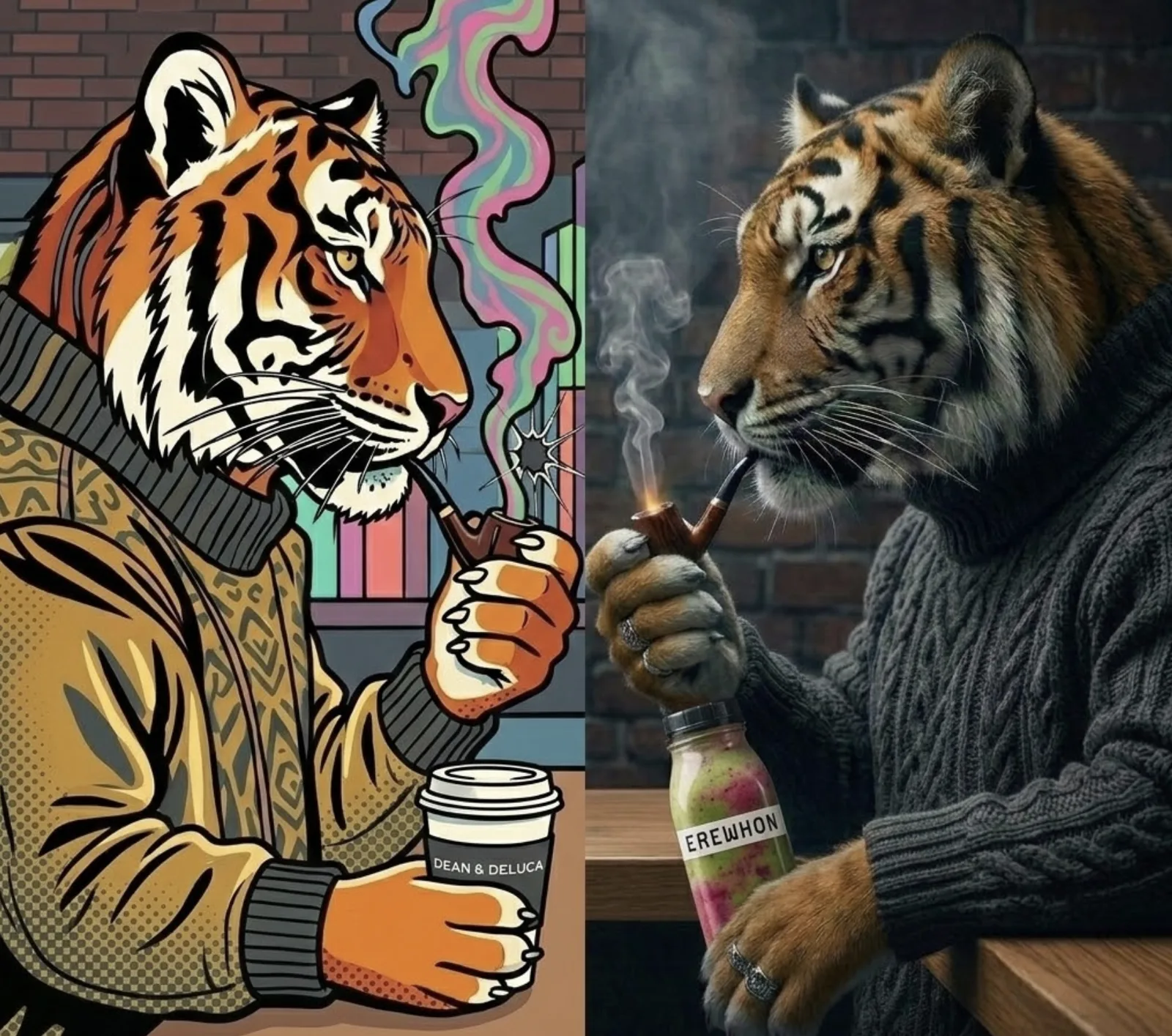
The “rhymes” quote is attributed to Mark Twain (though there's actually no record of him saying it). It reminds us that every new idea is an old idea in new packaging. It may not be identical, but we've done this all before, and we'll do it all again.
And maybe that's the most comforting thing to read on a day like today.
1. Erewhon Rhymes with Dean & DeLuca
When Dean & DeLuca opened on Prince Street in 1977, SoHo was starving artists and seedy lofts, not Balenciaga and Balthazar. But Dean & DeLuca started selling the idea that purchasing truffle oil and sundried tomatoes could make you a different kind of person. The space was designed like a gallery instead of a grocery store and the patrons agreed that their $14 balsamic vinegar was correctly priced for the perfect bourgeois prop that it was. By 2001, the brand was so synonymous with rarefied taste that Ridley Scott gave Dr Hannibal Lecter a Dean & DeLuca picnic box to accompany Ray Liotta's front lobe in the final scene of Hannibal. The most cultured cannibal in cinema history knew that only D&D was appropriately classy for his getaway meal.
Erewhon is that now. It is an institution based on the myth of the Beverly Hills zip code. The $19 Hailey Bieber smoothie is a membership card in liquid form. And the celeb collaborations are the modern Dean & DeLuca cheese counter: the thing you can buy that proves to the world that you belong there.
Eventually Dean & DeLuca went bankrupt. Not because the food got bad, but because they expanded their exclusivity to airports and strip malls and destroyed the elitist credentials of their product. And right on schedule, their heir apparent, Erewhon, is opening new locations outside LA. But the moment a brand like Erewhon becomes available to everyone, it will mean nothing to anyone.
Takeaway: If exclusivity is your product, the moment you try to franchise it, you've nullified the only value it ever had.
(Sources: Hannibal dir. Ridley Scott, 2001; Dean & DeLuca bankruptcy filing, 2018; Erewhon expansion, LA Times)
2. ChatGPT Rhymes with Xerox
Before the Xerox 914 machine came to offices in the 1960s, the currency of information inside a corporation was determined by hierarchy. If you read “the memo”, it was because the powers that be decided you were important enough to receive it. In fact, the market researchers who studied the copier predicted it had “no future in the office-copying market.” But they were asking executives. And they were very wrong.
By 1966, Americans were making 14 BILLION copies a year, democratizing the information that was previously restricted to a select few. The people who actually drove adoption were the secretaries, the ones lower in the hierarchy who understood instantly what the machine meant. The people higher up couldn't see it, because the machine threatened the information monopoly that justified their position. If a junior associate can get a copy of the senior partner's business, it shortens the distance to them becoming a senior partner.
That's ChatGPT right now. The junior analyst can produce a first draft that's 70% as good as the SVP's and may even cite more wide-ranging sources. The resistance from senior people isn't only about quality concerns. It's the same resistance the Xerox met: if my intern can produce this, what makes me the boss?
Takeaway: Every technology that democratizes output triggers the same identity crisis in the powerful. Xerox didn't kill the filing clerk. It killed the leverage of being the person who decided who got the file.
(Sources: CNN, "The office copier turns 50," 2010; David Owen, Copies in Seconds, 2004; Haloid Xerox press release, 1959)
3. Duolingo Rhymes with MTV
MTV launched in 1981 to play music videos. By 1992 it was the most culturally powerful brand in America and defined my own sense of coolness for 20 years. But by 2002, it barely played music at all. Cribs, Jackass, Punk'd — none of it had anything to do with the original mission. The media brand became so entertaining that nobody noticed the musicians had quietly exited the building. Tom Freston — the man who basically built MTV — watched it happen from the outside.
In a Fortune interview this past December about his memoir Unplugged, Freston said the decline started when they replaced music-obsessed creative producers with “traditional Hollywood show-maker type people.” But the most devastating detail is even more blunt: the company removed the words “Music Television” from its own MTV logo, effectively erasing the original product from its name. Freston said that “drove me crazy.” (But then again, Freston is claimed to have also said, “we don't sell music, we sell mood.”)
Duolingo's owl is the most recognizable brand mascot right now. Its TikTok account has more engagement than most celebs. But its actual language learning outcome is increasingly lost as most users plateau at an, “Où sont les toilettes?” level. In fact, the gamification part is so effective that people keep playing long after they've stopped trying to learn. But if the learning is gone, the popularity won't last.
MTV's ratings peaked after the music left, but once it wasn't MTV, it wasn't the best at anything. Duolingo's DAUs are at all-time highs while educational efficacy lags behind less famous competitors. Same characters, different movies.
Takeaway: When popularity becomes more important than the product, the product is already gone. You just can't tell yet because everyone's still watching.
(Sources: Fortune, Tom Freston interview, Dec 2025; Primetimer, "How MTV Branded the '80s")
4. Liquid Death Rhymes with Swatch
By the early 1980s, the Swiss watch industry was dead. Casio, Seiko and Japan had won. A quartz watch from Tokyo cost $20 and kept more reliable time than a $5,000 Rolex. In reaction, Swiss/Lebanese visionary businessman, Nicolas Hayek, formed the Swatch Group and did something that was neither rational, desperate, or very Swiss.
In a 1993 Harvard Business Review interview, he said: “Swatch is a triumph of engineering. But it is really a triumph of imagination.” The company's internal DNA phrase — still used today — is “positive provocation and joy of life.” That's the actual corporate philosophy of a watch company. Not precision. Not heritage. Provocation and joy.
Sound familiar? Liquid Death is water. You can get it for free from your sink. FIJI and Evian make expensive versions, and Coke owns the sugary shelf. But Mike Cessario did the Hayek move: he didn't enter the water market, he entered the identity market and put water inside it. The tallboy with death metal branding is like a Swatch in a can; it's a personality product in a commodity disguise.
And this was no fluke. Swatch succeeded so wildly that it saved the entire Swiss watch industry. The profits from the goofy watches funded the revival of Omega, Tissot, Longines. Hayek became the first “Business Celebrity” and The Swatch Group became the largest watch company in the world.
Takeaway: Liquid Death's real legacy is continuing to show performance and data leaders that personality is a viable strategy in commodity categories. Cessario is Hayek — thirty years later, same thesis, different shelf.
(Sources: HBR, "Message and Muscle: An Interview with Swatch Titan Nicolas Hayek," March 1993; Swatch Group corporate history; Liquid Death valuation reporting, 2024)
This Week's Red Thread: Listening for the Rhyme
Five years ago, I told my Gen Z students in my graduate advertising class that, “TikTok is just the new QVC” and they all scoffed, offended that I was slandering their beloved TikTok creators by comparing them to “In the Kitchen with David”.
But now it's a common comparison: a charismatic host selling you something in real time while you sit on your couch. The only difference is that on TikTok, the host is 23 and the remote is your thumb.
The format didn't evolve. It just migrated.
Every week in this newsletter I try to find the common signal within the noise. This week, the signal is the noise itself — the constant breathless announcement that everything is unprecedented, and that we're living through a level of disruption nobody could have predicted, that the old rules don't apply.
They do.
They always did.
Dean & DeLuca showed us what will happen when Erewhon tries to scale exclusivity. The Xerox machine showed us what will happen when ChatGPT levels the information playing field. MTV showed us what will happen when Duolingo's popularity outshines the product. And Swatch already showed us how Liquid Death's personality can beat commodity.
I'm no Scott Galloway, and I'm not claiming to actually predict the future. But recognizing the past when it shows up wearing different clothes is easier than we think. And the people who hear the rhyme first can be the ones who get to write the next verse.
— NB