SUNDAY SCARIES: American Dreams
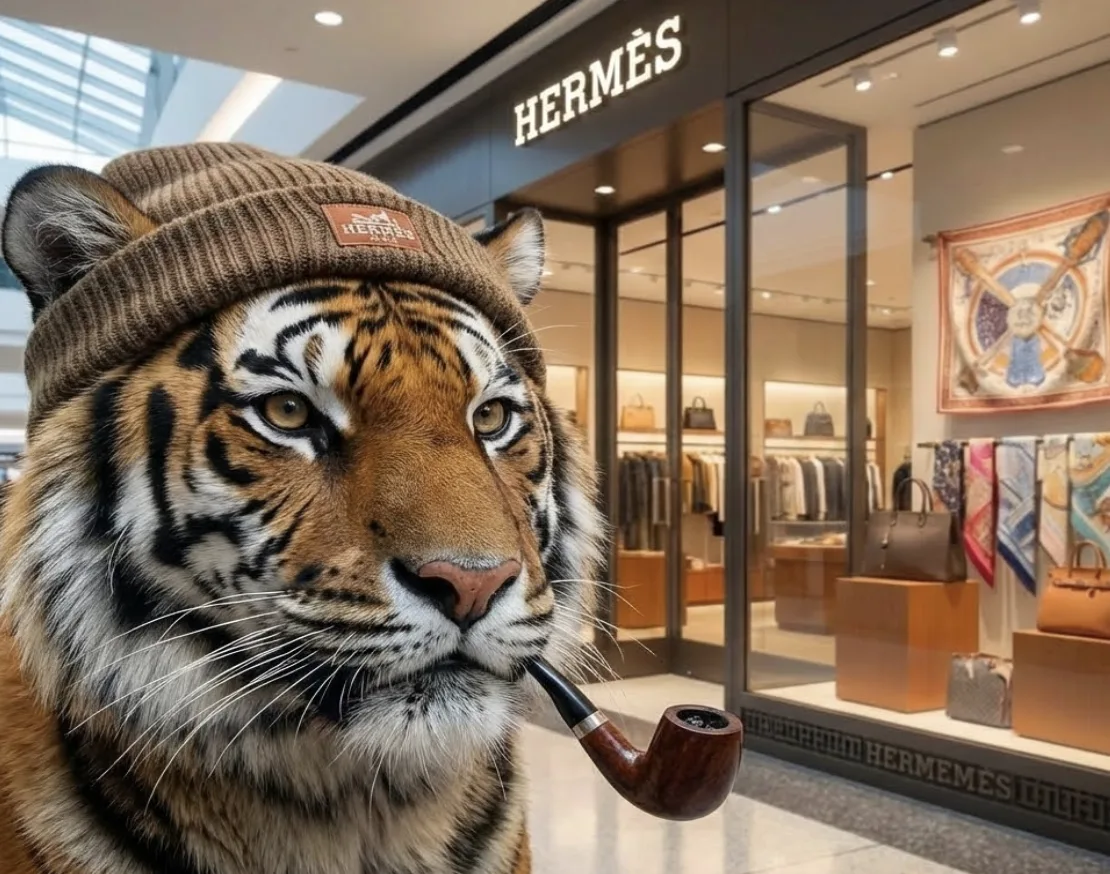
This weekend I went to American Dream Mall in East Rutherford, New Jersey, which inspired the metaphorical and literal lens for the week.
American Dream Mall is a $5 billion monument to late stage capitalism. It took 19 years to build, survived bankruptcy, and now contains an indoor ski slope, a water park, a Nickelodeon Universe, dozens of themed food courts, luxury retail that includes Hermès, Rolex, Cartier, and — inside Korean eyewear store Gentle Monster — there's even a trio of life-sized taxidermied white buffaloes, as if the symbolism wasn't on the nose enough. It's the American Dream of Walt Whitman, Horatio Alger, and Upton Sinclair all at once.
1. The Dream of Abundance
Hermès posted +14% revenue growth in Q4. Birkin waitlists now stretch past six years. LVMH reported record profits. Meanwhile, Target, Gap, and Kohl's are watching traffic crater and earnings collapse. The luxury customer is thriving. The middle-market customer has disappeared.
It's not just because of the economy (though the Gilded Age 2.0 isn't helping much). It's that the middle seller stopped offering anything worth wanting. Not scarcity. Not values. Just stuff. The promise that “more stuff = better life” is no longer an American dream. Only the extremes survive.
Hermès works because it's unapologetically exclusive. If you can't get it, that's the point. The middle offers neither aspiration nor conviction. It's stuff that could be anything, for people who could be anyone. And Americans no longer want to just build identities around “stuff.”
It's not that people are saving money, or being responsible. Americans are resisting spending on things that are just things. Because having something that means nothing is not better than having nothing at all.
Takeaway: In America today, you're either buying the Birkin or you're not buying much at all. The space between luxury and refusal has evaporated. "Stuff" doesn't sell.
(Sources: Hermès Q4 2025 earnings report; LVMH financial results; Target Q3 2025 earnings call; Dentsu Culture Insights)
2. The Dream of Progress
Amazon just shut down all 15 Amazon Go stores and all 57 Amazon Fresh locations nationwide. But they're not abandoning retail — they're doubling down on Whole Foods and licensing Just Walk Out technology to 360+ third-party locations like airports and stadiums.
The promise of convenience was supposed to liberate us. Frictionless checkout, one-click everything, shopping so efficient you barely notice you're doing it. But without an experience that creates memory, there's no reason to return.
Meanwhile at American Dream, the stores people wait for aren't the most convenient — they're the most demanding. I had to elbow my way in to take a picture of Gentle Monster's life-sized taxidermied white buffaloes. BAPE uses velvet ropes even when there's no line to get in. Hermès had as many people rushing to get in as there were waiting for their ChickenJoy from Jollibee.
These brands aren't selling speed. They're selling friction. The waiting, the spectacle, the longing — that's where memory is born. Not in the transaction. In everything around it. Even the throngs of 13 year old girls in Sephora and Ulta desperately searching for the secret to looking 12 again are there, not because they're aging, but because they feel the need to BE there.
Takeaway: Progress promised that efficiency would free us. Instead, friction is what makes us feel anything. The stores winning aren't faster — they're unforgettable.
(Sources: Amazon retail Jan 2026; Vogue Business, "The Flagship Renaissance"; BoF "Why Permanent Retail is Winning")
3. The Dream of Invincibility
Walking through the mall, you'd have a tough time putting a firm date on the clothes being worn by Gen Z: oversized hoodies, baggy jeans, vintage tees, normcore sneakers. And all those silhouettes from 2016. But this isn't just a trend cycle. It's emotional time travel.
America promised its citizens would walk through the world confident, exceptional, unafraid. By extension, our cultural uniforms were supposed to project that power: “dress for success”, “look sharp”, show the world you're “winning.”
Instead, Gen Z is dressing like their parents' childhood. Not because they love the '90s. Because the '90s were when America made it feel safe to be American.
“2026 is the new 2016” became a viral TikTok caption with Gen Z stitching footage of house parties and mall hangs, imagining young adulthood that felt “spontaneous and frictionless.” Because 2016 was the last year before American exceptionalism visibly cracked.
Harvard's Youth Poll found Gen Z defined by “economic insecurity, deep anxiety, and corrosive distrust of institutions.” The Robin Report noted fashion is “fueled by nostalgia for the millennial hipster life of the 2010s” amid a “no-hire, no-fire” labor market.
So they dress like 1999. Or 2007. Or 2016. Any year when America still felt like it worked.
Takeaway: America promised its people would be invincible. Instead, they're cosplaying eras when invincibility still felt real. When exceptionalism fails, nostalgia becomes the uniform.
(Sources: Fortune "Gen Z's nostalgia for 2016 vibes"; The Robin Report "State of Gen Z 2026"; Harvard Youth Poll Fall 2025; Istituto Marangoni)
4. The Dream of Democracy
America promised that your voice matters. That you could vote, organize, petition, protest — and change would follow. That democracy was how the people held power accountable.
But the state of our constitutional rights is in such disarray, perhaps nothing is guaranteed except for the power of money.
Scott Galloway's Resist/Unsubscribe is just the latest in a growing ecosystem of consumer boycotts targeting ICE collaborators. The companies enabling deportations include AT&T, Palantir, Amazon Web Services, Dell, Lowes and Home Depot, Salesforce, Comcast, Marriott, Microsoft, and Motorola — the full infrastructure making mass deportation scalable.
Earlier this month, Avelo Airlines — which ran 17% of all ICE deportation flights in November 2025 — ended its contract after sustained pressure from coalitions across the country. Spotify stopped running ICE recruitment ads. Hilton is facing campaigns for retaliating against hotels that refused service to ICE agents.
American Dream Mall — cathedral for the greatest economy in the world — isn't where policy would be changed. But you can choose not to fund it. You can vote your conscience about whether you're comfortable funding the machinery that tears families apart while shopping for a phone. Because when democracy stops responding to voters, consumer spending becomes the only civic action left.
The American experiment is just another brand in need of paying customers. Even the person living in the White House knows he's only as powerful as his brand is profitable.
Takeaway: America promised your vote would matter. Now your credit card is the only ballot that still counts.
(Sources: PIVOT; resistandunsubscribe.com; Truthout "Corporations Collaborating with ICE"; Fortune; Washington Post)
This Week's Red Thread: American Dreams and American Reality
American Dream Mall promises everything all the time: Luxury. Entertainment. Novelty. The future of retail. The reality? Exhaustion.
Because American Dream isn't just a mall. It's the United States of America in miniature.
It's the false consumerist reward sold by Horatio Alger. The cruel capitalism warned of by Upton Sinclair. And even the existential optimism of Whitman (who probably would have loved Uggs).
The gap between what America promised and what it delivers has never been wider. And in that gap, people are improvising survival strategies: boycotting with credit cards because votes don't count, refusing to buy because restraint is identity, dressing for protection because confidence is no longer available.
American Dream cost $5 billion and took 19 years to build. It's spectacular, incoherent, awe-inspiring and totally overwhelming. And it's impossible to leave without feeling like you were sold something you didn't ask for.
Just like the country it's named after.
— NB