SUNDAY SCARIES: Absent Mothers of Invention
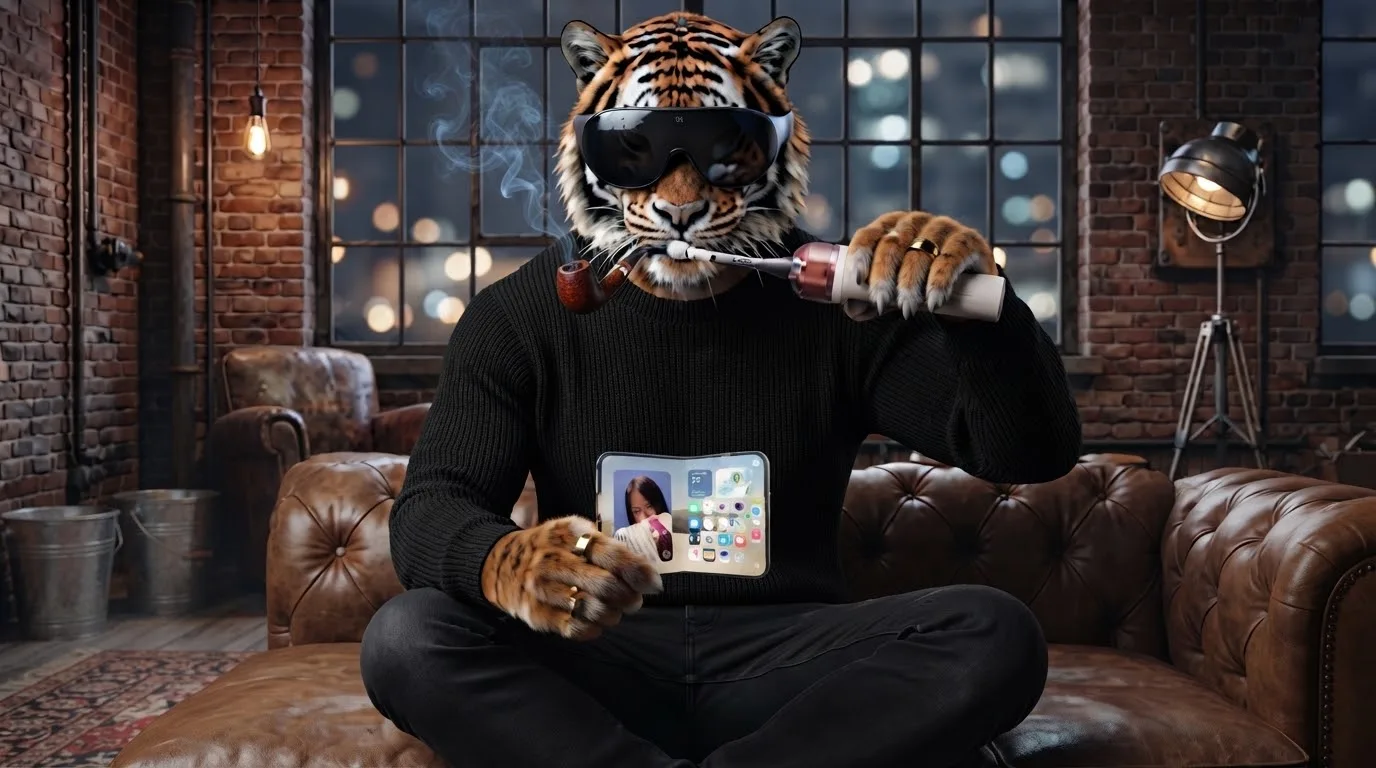
Over the last few weeks, we saw the announcement of a new folding phone for $3,000, a toothbrush with a camera for $499, a pair of $1,300 glasses that should never be worn in public, and a ring whose parent company is asking Wall Street for a valuation of $15.6 billion.
The proverb says “necessity is the mother of invention”, but the lineage for these inventions has some foggy DNA.
1. Sex Repellant Goggles
On Wednesday Meta announced its new VR Glasses, which cost $1,299.99, weigh about 100 grams on your face, and are tethered by a cable to a 300-gram computer puck that rides in your pocket like a giant pager from 1994.
They’re pitched first as a personal movie theater, IMAX certified, with Disney’s 3D films arriving in November, and they look less like the headsets Meta and Apple have sold before and more like the wraparound shades they hand you after a cataract surgery. In the same keynote Meta introduced its first smart glasses with no camera at all, sold on privacy, (which makes them the first Meta product I can think of that’s also an apology.)
To be fair, the AI glasses as a category itself has started to sell. AI glasses shipments rose 263% in the first half of this year, and the Ray-Bans are most of the reason. But the people who bought the last pair are the ones who gave them their “perv” reputation, and a heavier pair with a wire running into your pants isn’t going to help anyone who needed more help interacting with fellow humans than the glasses could provide.
Takeaway: Meta can engineer almost anything except an ideal customer profile, or ICP.
(Sources: Engadget, September 23, 2026; VR.org, September 23, 2026; Tom’s Guide, September 23, 2026)
2. Reheated Korean Leftovers
Two weeks ago Apple introduced the iPhone Duo, its first foldable, with a max price of over $3000, and CEO John Ternus called it “the most transformational change to iPhone since the original.” Yet Samsung released the first Galaxy Fold in 2019 and has since shipped eight generations of it, the current one starting at $1,899.99, and its US Instagram account responded the way any older sibling would: “Let us know when you’re done reheating our leftovers.”
What Apple has mastered over the decades is making the thing feel brand new, and it works so well that the whole market comes down with the same amnesia every September. The exception is inside the Korean competitor, where Apple is known as “LO,” the Loved One, frustratingly and inexplicably adored no matter how many times Samsung got there first with the better screen, the better camera and the lower price. What’s more is that according to a report out of the Asian supply chain, the folding screen inside the Duo is made by Samsung Display, on a three-year exclusive, at about $250 a panel.
Takeaway: Even though the product had existed for seven years, it was still invented the day Apple said so.
(Sources: Apple Newsroom, September 9, 2026; Gulf News, September 2026; MacRumors, September 11, 2026; Samsung US, September 2026)
3. “Just Floss.”
On September 1 in Paris, Dyson unveiled the CameraJet, a $499 electric toothbrush with a 100,000-pixel macro camera in the head that shoots 28 images a second, an AI trained on 470,000 photographs of teeth, and a jet that finds the gaps between them in about a tenth of a second and fires mouthwash into them. It took six years, 661 engineers, 38 patents and sixteen million lines of code, and James Dyson explained the need himself: “Flossing is an awkward and time-consuming chore. Few of us do it even though we know we should.”
Nobody can seriously argue this is essential to anyone’s oral hygiene, since the cure for not flossing has been flossing for about as long as there has been string. Consumer Reports’ first unit was dead within 24 hours, and on the replacement, water and toothpaste kept fogging the lens, which is a tough problem to engineer around in a toothbrush. The tech reviewer Quinn Nelson got the whole review down to eight words: “just brush your teeth and then floss them.” And somewhere in six years and 661 engineers, somebody had a chance every single week to put this thing down and walk away.
Takeaway: Dyson handed its engineers a problem that none of its customers actually had.
(Sources: Dyson via PR Newswire, September 1, 2026; BuzzFeed, September 2026; Consumer Reports, September 23, 2026)
4. Oura’s $6 Million IPO
I wear an Oura ring, along with about five million other paying members, and it’s one of the few gadgets I’d notice if it went missing. It’s good at tracking my life and doesn’t require me to wear something instead of my watches.
The company is also very good at making money: $60.8 million in net income over the nine months to June, membership revenue up from $108.8 million to $240.5 million at an 89% gross margin, and another $974 million from the rings themselves. Last Monday it launched its IPO at $40 to $44 a share, about a $15.6 billion valuation, and it prices on Nasdaq this week.
But 73% of the shares for sale belong to existing investors, and Forerunner, which backed Oura in 2020, is selling its entire stake for about $1.2 billion. Of the roughly $567 million that goes to the company, about $526 million pays the taxes on employee stock, which leaves Oura around $6 million for the business of being Oura.
Eli Lilly, meanwhile, has lined up to buy as much as $100 million of the stock, which tells you who else has been paying attention to what’s on your finger.
Takeaway: Five million people pay Oura for a membership (including me), and when it goes public, about three of every four dollars raised will go to investors who are cashing out.
(Sources: TechCrunch, September 21, 2026; Yahoo Finance, September 2026; Inc., September 21, 2026)
This Week’s Red Thread: Who Needs It?
On September 3 in Zurich, the Ig Nobel Prize for Physics (a yearly joke prize that’s basically like The Onion + Pulitzer but for scientists) went to a team of fluid dynamicists at the University of Waterloo, for a urinal that doesn’t splash back.
These physicists worked out that the splash mostly stops when the stream meets the porcelain at thirty degrees or less, then shaped a urinal, low and curved enough for kids and wheelchair users too, where every inch of the surface holds that angle, in a fixture whose design, by their account, hadn’t really changed in over a century. By their math, swapping in the new design across America’s public restrooms would keep about a MILLION liters a day off the floor. When one of the winners was asked why any of it mattered, he went straight to the need: “I don’t know if you’ve ever been in a urinal and wore sandals, you sometimes feel those droplets.”
An old adage in business, one particularly favored by Horace Hagedorn, the founder of my former employer, Miracle-Gro, is to “find a need and fill it.”
Every invention this month came from extraordinary companies and people with enormous budgets, but everything seemed to start from a want inside the company and not a need. Meta wanted its glasses to stand for something new, Apple just wanted to catch up even seven years late, Dyson wanted something for 661 engineers to do, and Oura’s investors wanted to get paid.
Steve Jobs famously told BusinessWeek in May 1998, the same month he unveiled the iMac, “A lot of times, people don’t know what they want until you show it to them.”
He was right about his own career, and he had the iMac, the iPod and the iPhone to prove it. But each of those answered a need people already had and couldn’t put into words. Twenty-eight years later it’s the most borrowed sentence by entrepreneurs who want to put cameras on toothbrushes.
— NB